Last week, Steven Weinberg gave a talk in Arlington, Texas. This is the questions-and-answers part of the talk:
It's 28 minutes. At the end of the regular talk, he mentioned various indirect advantages from building a new linear collider etc. He makes a good joke when they prepare an award for his memorable talk: How did you know in advance that my talk would be memorable? I would be inclined to make exactly the same comment.
A person asked about new physics. Weinberg focused on the identity and detection of the dark matter particle. The same person and another one wanted to ask about string theory – that's what people are really excited about. Weinberg said it's extraordinarily mathematically powerful and it hasn't been possible to compare its characteristic predictions with experiments.
He says that the International Space Station was allowed to go at the same time when the Superconducting Supercollider was cancelled – even though it was 10 times more expensive and has produced no science. He strengthens the claim by saying that the astronauts have never produced any science. Of course, some people in the audience are stunned, others applaud. ;-)
The linear collider would measure the properties of the Higgs and all the things much more accurately. I have some doubts whether this information is worth $10 billion dollars, especially because it is somewhat likely (40%?) that they would exactly agree with the Standard Model, within the ILC precision. And if there were a disagreement, it would still fail to clarify where the disagreement comes from, what are actually the new particles and physical phenomena that are responsible for the deviation. Imagine that the ILC finds out that the diphoton decays of the Higgs boson are indeed 70% more frequent than the Standard Model says. Would we be fully excited and satisfied? Nope. It would only be a justification to build a collider that may actually find the new beasts that are responsible. So why wouldn't we build this collider immediately?
For those reasons, I would tend to think it's better to save a little bit more money and build a new SSC-like collider that exceeds the LHC by its superior brute force, by the energy.
Weinberg said that he was attracted to theoretical physics by reading popular books when he was at the high school. He also mentions that for a long time, he believed he had to know everything before he starts to do research, so he was reading lots of books. Then he learned better. Well, I still think that his previous "mistake" was very valuable because it gave us Weinberg who really did and does know everything about the particle physics and cosmology of his era.
Most of the time, nothing comes out of the research so it may be frustrating. Sometimes, something comes out. If you love it, do it, if you don't, then don't do it...
Weinberg's Arlington talk was a part of a broader linear collider conference (its web).
Showing posts with label science and society. Show all posts
Showing posts with label science and society. Show all posts
Sunday, November 4, 2012

Thursday, November 1, 2012
Paul Frampton: from prison to house arrest
For everyone who have been at least a bit worried about Paul Frampton who got fooled by a fake Czech Californian supermodel in Argentine whose gang inserted some drugs to his luggage, there is some semi-good news.
It's progress and let's hope it's not the final one. By the way, a few days ago, Paul recommended UNC to double his salary.

I spent 3 minutes by searching a picture at Google Images where Denise Milani, Paul's believed sweetheart, is mostly dressed – I hope you appreciate the work. ;-)
Via JoAnne Hewett's FB (and via B Chimp Yen).
Drugs suspect freed from jail, Google NewsThe officials finally noticed that Paul coughs badly. Paul will stay with an old friend who lives in Buenos Aires.
It's progress and let's hope it's not the final one. By the way, a few days ago, Paul recommended UNC to double his salary.
I spent 3 minutes by searching a picture at Google Images where Denise Milani, Paul's believed sweetheart, is mostly dressed – I hope you appreciate the work. ;-)
Via JoAnne Hewett's FB (and via B Chimp Yen).
Edward Teller's great H-day: 60 years ago
Ivy Mike released 188 times more energy than Hurricane Sandy
Update: All claims below based on the Sandy energy numbers are wrong and reflecting a temporary credulity and stupidity of mine. See comments for some discussion
Hungarian-Jewish-American physicist Edward Teller had a great day exactly 60 years ago, on November 1st, 1952. For some years, he's been working on an idea originally due to the great physics guru Enrico Fermi (most likely, and one invented in Summer 1942) which totally fascinated him: a bomb getting its energy from thermonuclear fusion.
While fission only releases about \(0.001E=0.001mc^2\) from some mass, fusion is able to get to \(0.01E=0.01mc^2\), one percent of the total latent energy, and it may employ as omnipresent "fuels" as hydrogen.

See the explosion here – the blast (the "Mike shot") takes place at 4:39 – or here at 1:40. There's also a one-hour 1952 program where the explosion occurs at 40:47. Is it just me who feels that the 1950s Americans sound more British? ;-)
Ivy Mike, the pioneering device based on the Teller-Ulam design, was finally ready for detonation on the Enewetak Atoll (atoll = coral island encircling a lagoon) in the Pacific Ocean: Google Maps, crater (yes, the Elugelab [codenamed Flora] island in the the atoll [not the whole atoll whose radius is 15 km!] ceased to exist and was filled with water; before, after, source).
This device was one of the main reasons we have had peace for many and many decades; Edward Teller should have clearly gotten the Peace Nobel Prize that was jokingly given to the "European Union". How strong was the explosion? And how did the device work?
At the center of the device, there was a cylindrical rod of plutonium, the "sparkplug", that had the task to ignite the fusion reaction. It was surrounded by a natural five-ton uranium "tamper". The external side of the tamper was made of a mixture of lead and polyethylene and these sheets were sending X-rays from the primary to the secondary. The X-rays acted by their huge pressure and temperature.
All the lead, plutonium, and uranium stuff was there just to help the primary actor that was being tested – the cryogenic (=impractical for mobile bombs) liquid deuterium fuel at the very center (plus some tritium) – to get a bit excited and warmed up.
The whole active object, also named "sausage", was encapsulated in 25-30 centimeter thick steel. This whole toy was 54 tons heavy, 619 cm tall, and 203 cm in diameter. With other external components, Ivy Mike weighed over 80 tons (again, that's why it was impractical for mobile weapons). When it exploded, it produced 10-12 megatons of TNT but 77% came from the fission of the uranium "temper" (about 450 kg out of 4.5 tons of the uranium was "burned" releasing the equivalent of almost 8 megatons of TNT) but the remaining 23% may be attributed to fusion. The fireball was 5 km wide and the mushroom went to 17 km altitude in 90 seconds and 30 km in 150 seconds.
Note that 10 megatons of TNT is about 41.84 petajoules i.e. \(41.84\times 10^{15}\,{\rm J}\). Via \(E=mc^2\), that's equivalent to the complete destruction of 0.47 kilograms of matter. Take one-quarter of it (for fusion) and multiply it by 100 to see that about a kilogram of hydrogen was turned mostly into helium or new tritium (and other things).

Via Nuclear Secrecy.COM.
Alexander Ač told us about the energy stored in the otherwise mediocre Hurricane Sandy. His source states that Sandy "contained" – whatever it exactly meant – 0.222 petajoules of energy. It's only larger than the analogous numbers for other, stronger storms because Sandy's figure includes the wind energy from a larger area. If you know how to divide numbers, you can easily calculate that Ivy Mike released the same energy as 188 times the Hurricane Sandy. And it was pretty much produced by one right-wing physicist. That's a simple quantitative explanation why you shouldn't expect right-wing physicists to be overly impressed by the energy of the Hurricane Sandy. ;-)
But if the worshipers of the greenhouse effect and its hypothetical but indefensible effects on the weather events feel humiliated, and they surely should because they are, let me calm them down just a little bit. The research project initiated in 1951 that led to Ivy Mike had a nice name: the Greenhouse. :-D
(Yes, I needed Ivy Mike whose energy was equivalent to 750 Hiroshimas. Hiroshima wasn't enough to beat Sandy; it released about 1/4 of Sandy's energy. On the other hand, NYC rats are stronger than Sandy.)
The crater created by the blast was 3 km wide and 60 meters deep. 80 million tons of rocks were vaporized. The blast didn't proceed as expected – it was two times better i.e. stronger. One pilot who was supposed to pick some air samples died when he ran out of fuel. All elements including Einsteinium and Fermium were produced. A 50-kilometer vicinity of the atoll was substantially radioactively contaminated. You don't want to play with similar toys in the New York City; Sandy is just fine.
Harry Truman who politically supervised the research wasn't the only one. At that time, the Soviets were already working on something similar although their research was arguably not quite independent. Sakharov's Third Idea – the Slavic term for the Teller-Ulam design – got tested in 1955, three years after Ivy Mike (6 times lower yield than Ivy Mike). But already in 1953, one year after Ivy Mike, the USSR tested Joe 4 (0.4 megatons of TNT, 25 times smaller than Ivy Mike) based on a different "Sloika" philosophy. The strongest (thermonuclear or otherwise) man-made explosion ever (so far?) was the Tsar Bomba in 1961. At 57 megatons of TNT, it was 5 times stronger than Ivy Mike and 1,000 times stronger than Hurricane Sandy. Take it, Yankees and weather alarmists. ;-)
Hat tip: Technet.iDNES.cz
P.S.: Just a comment on the energy vs world energy consumption. The Ivy Mike blast may look very large and you could think that it would be great to use it as a generator of energy. But I mentioned that the blast released \(4\times 10^{16}\) joules of energy. It's a lot but the world's annual energy consumption is around \(4\times 10^{20}\) joules so you would have to tame 10,000 Ivy-Mike-like blasts a year to replace the existing sources of energy! But you could imagine it's doable. Forget about peaceful thermonuclear power plants and use a blast to raise a lot of matter to some altitude, or heat it, or something like that. 30 such Ivy Mike blasts a day may produce the electricity for the whole mankind. ;-)
Update: All claims below based on the Sandy energy numbers are wrong and reflecting a temporary credulity and stupidity of mine. See comments for some discussion
Hungarian-Jewish-American physicist Edward Teller had a great day exactly 60 years ago, on November 1st, 1952. For some years, he's been working on an idea originally due to the great physics guru Enrico Fermi (most likely, and one invented in Summer 1942) which totally fascinated him: a bomb getting its energy from thermonuclear fusion.
While fission only releases about \(0.001E=0.001mc^2\) from some mass, fusion is able to get to \(0.01E=0.01mc^2\), one percent of the total latent energy, and it may employ as omnipresent "fuels" as hydrogen.

See the explosion here – the blast (the "Mike shot") takes place at 4:39 – or here at 1:40. There's also a one-hour 1952 program where the explosion occurs at 40:47. Is it just me who feels that the 1950s Americans sound more British? ;-)
Ivy Mike, the pioneering device based on the Teller-Ulam design, was finally ready for detonation on the Enewetak Atoll (atoll = coral island encircling a lagoon) in the Pacific Ocean: Google Maps, crater (yes, the Elugelab [codenamed Flora] island in the the atoll [not the whole atoll whose radius is 15 km!] ceased to exist and was filled with water; before, after, source).
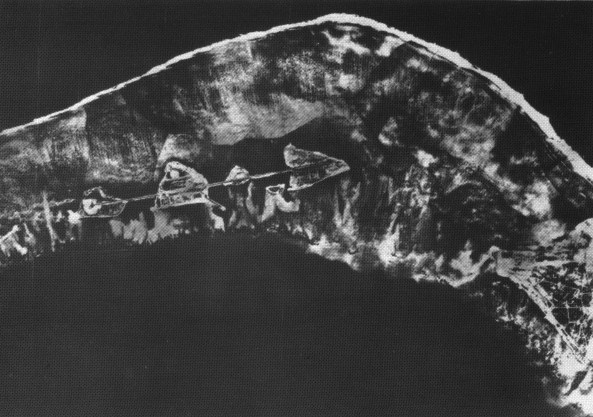
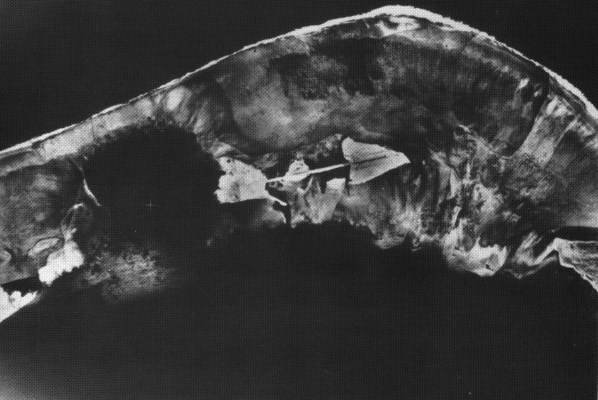
This device was one of the main reasons we have had peace for many and many decades; Edward Teller should have clearly gotten the Peace Nobel Prize that was jokingly given to the "European Union". How strong was the explosion? And how did the device work?
At the center of the device, there was a cylindrical rod of plutonium, the "sparkplug", that had the task to ignite the fusion reaction. It was surrounded by a natural five-ton uranium "tamper". The external side of the tamper was made of a mixture of lead and polyethylene and these sheets were sending X-rays from the primary to the secondary. The X-rays acted by their huge pressure and temperature.
All the lead, plutonium, and uranium stuff was there just to help the primary actor that was being tested – the cryogenic (=impractical for mobile bombs) liquid deuterium fuel at the very center (plus some tritium) – to get a bit excited and warmed up.
The whole active object, also named "sausage", was encapsulated in 25-30 centimeter thick steel. This whole toy was 54 tons heavy, 619 cm tall, and 203 cm in diameter. With other external components, Ivy Mike weighed over 80 tons (again, that's why it was impractical for mobile weapons). When it exploded, it produced 10-12 megatons of TNT but 77% came from the fission of the uranium "temper" (about 450 kg out of 4.5 tons of the uranium was "burned" releasing the equivalent of almost 8 megatons of TNT) but the remaining 23% may be attributed to fusion. The fireball was 5 km wide and the mushroom went to 17 km altitude in 90 seconds and 30 km in 150 seconds.
Note that 10 megatons of TNT is about 41.84 petajoules i.e. \(41.84\times 10^{15}\,{\rm J}\). Via \(E=mc^2\), that's equivalent to the complete destruction of 0.47 kilograms of matter. Take one-quarter of it (for fusion) and multiply it by 100 to see that about a kilogram of hydrogen was turned mostly into helium or new tritium (and other things).

Via Nuclear Secrecy.COM.
Alexander Ač told us about the energy stored in the otherwise mediocre Hurricane Sandy. His source states that Sandy "contained" – whatever it exactly meant – 0.222 petajoules of energy. It's only larger than the analogous numbers for other, stronger storms because Sandy's figure includes the wind energy from a larger area. If you know how to divide numbers, you can easily calculate that Ivy Mike released the same energy as 188 times the Hurricane Sandy. And it was pretty much produced by one right-wing physicist. That's a simple quantitative explanation why you shouldn't expect right-wing physicists to be overly impressed by the energy of the Hurricane Sandy. ;-)
But if the worshipers of the greenhouse effect and its hypothetical but indefensible effects on the weather events feel humiliated, and they surely should because they are, let me calm them down just a little bit. The research project initiated in 1951 that led to Ivy Mike had a nice name: the Greenhouse. :-D
(Yes, I needed Ivy Mike whose energy was equivalent to 750 Hiroshimas. Hiroshima wasn't enough to beat Sandy; it released about 1/4 of Sandy's energy. On the other hand, NYC rats are stronger than Sandy.)
The crater created by the blast was 3 km wide and 60 meters deep. 80 million tons of rocks were vaporized. The blast didn't proceed as expected – it was two times better i.e. stronger. One pilot who was supposed to pick some air samples died when he ran out of fuel. All elements including Einsteinium and Fermium were produced. A 50-kilometer vicinity of the atoll was substantially radioactively contaminated. You don't want to play with similar toys in the New York City; Sandy is just fine.
Harry Truman who politically supervised the research wasn't the only one. At that time, the Soviets were already working on something similar although their research was arguably not quite independent. Sakharov's Third Idea – the Slavic term for the Teller-Ulam design – got tested in 1955, three years after Ivy Mike (6 times lower yield than Ivy Mike). But already in 1953, one year after Ivy Mike, the USSR tested Joe 4 (0.4 megatons of TNT, 25 times smaller than Ivy Mike) based on a different "Sloika" philosophy. The strongest (thermonuclear or otherwise) man-made explosion ever (so far?) was the Tsar Bomba in 1961. At 57 megatons of TNT, it was 5 times stronger than Ivy Mike and 1,000 times stronger than Hurricane Sandy. Take it, Yankees and weather alarmists. ;-)
Hat tip: Technet.iDNES.cz
P.S.: Just a comment on the energy vs world energy consumption. The Ivy Mike blast may look very large and you could think that it would be great to use it as a generator of energy. But I mentioned that the blast released \(4\times 10^{16}\) joules of energy. It's a lot but the world's annual energy consumption is around \(4\times 10^{20}\) joules so you would have to tame 10,000 Ivy-Mike-like blasts a year to replace the existing sources of energy! But you could imagine it's doable. Forget about peaceful thermonuclear power plants and use a blast to raise a lot of matter to some altitude, or heat it, or something like that. 30 such Ivy Mike blasts a day may produce the electricity for the whole mankind. ;-)
Wednesday, October 31, 2012
Was Sandy systemically caused by CO2?
Anthony Watts wrote down a nice table describing which folks believe or at least pretend to believe that CO2 "caused" Hurricane Sandy and which people don't. If I simplify it a little bit, activists, liars, and crackpots such as Al Gore support the link while scientists don't. I am kind of pleased to see that for the first time, most of the media seem to agree that the people promoting the hurricane-CO2 link are hacks.
I was intrigued by a member of the former group, hardcore leftist activist Mr George Lakoff, who wrote the following text for the Huffington Post:
Except that Mr Lakoff believes that AIDS is only "systemically caused", not "directly caused", by the HIV virus. That's pretty interesting. Either he is an HIV denier or his definition of "systemic causation" is internally inconsistent. But let's ask two questions: Was Sandy "systemically caused" by CO2 emissions? And forgetting about the answer and focusing on genuine "systemic causes" of bad events in general, is it legitimate for the society to outlaw them?
My answer to both questions is No, although the latter question deserves a subtler discussion.
Unless you believe in astrology and similar things, you will surely agree that it's not in the power of CO2 or any other indirect hypothetical causes to adjust some "highly internal" and "seemingly random" characteristics of tropical storms such as the population of the city that the storms target. ;-)
So the fact that Sandy managed to flood some tunnels in the New York subway system, among dozens of related achievements, is pretty clearly a coincidence that can't be explained by any well-defined long-term "cause", not even a "systemic cause". Most hurricanes avoid New York, some hurricanes get there, and only the proportion may be measured or theoretically calculated. In other words, when we talk about unknown future hurricanes, we may only predict their ability to target New York or other great cities probabilistically. And we may only estimate the probability that the most important hurricane of 2013 will make landing at most 4 days before the Halloween.
(The same comment, "only probabilistic predictions are possible", obviously applies to earthquakes in Italy, too.)
Needless to say, exactly the same words apply to Katrina and New Orleans in 2005. Katrina was a big story – much bigger than Sandy (surely by the number of casualties) – because it hit a large and relatively vulnerable city of New Orleans. Sandy was a relatively big story because it affected the "greatest city in the world" although not as much as Katrina did harm New Orleans. Let's agree that the targeting is a matter of chance.
But if you subtract all the "special characteristics" of Sandy that are related to its random path, there is almost nothing left. In fact, by the Accumulated Cyclone Energy (ACE), Sandy isn't even the largest storm of the 2012 Atlantic hurricane season. It's not even the second one. It's not even the third one: Sandy is just the fourth largest Atlantic tropical storm of 2012. That shouldn't be shocking because it has made it to the Category 2 and only marginally and for a short time.
One may look for various detailed properties of Sandy – its trajectory, its area, its pre-Halloween timing, and so on. But I think it's clear that trying to attribute some "message" (I would say "divine message") to any of these detailed properties is a sign of medieval superstitions. People who try to interpret these properties as divine signals may use a quasi-scientific vocabulary but the vocabulary isn't the essence. The essence is the logic behind their thoughts and beliefs and it is equally unscientific as any other generic medieval superstitions.
The fact that Sandy went to New Jersey is a coincidence – one that could be predicted a few days in advance but one that has no implications for any knowledge or mechanisms that are relevant outside the end of October 2012. The fact that Sandy hit before the Halloween or before the U.S. presidential election is another coincidence. It's totally scientifically implausible to assign "causes" or "systemic causes" to such microscopic accidental characteristics of a tropical storm. Such links are equivalent to astrology and other superstitions. There isn't any conceivable natural mechanism that could impose such causal links – and there's even no conceivable mechanism or explanation that could significantly increase the chance that a hurricane is more Sandy-like if the CO2 concentration is higher. I am convinced that everyone who has been given basic scientific education – or who has a basic scientific intuition even in the absence of any formal education – must know that.
So we are back to the usual questions whether the carbon dioxide in the atmosphere may be increasing or decreasing the number or hurricanes or their average or maximum intensity. I think that the data speak a clear language: no such dependence, whether positive or negative, may be extracted from the data that seem to be fully explainable by "noise", essentially "white noise". In the future, the datasets will become more extensive and perhaps more accurate and people may see a signal we don't see today. That's why it makes sense to ask whether we may predict what they will see. I think (based on arguments I have been repeatedly explained by Richard Lindzen in particular) that if they will ever see such an impact, it should be a negative impact – fewer hurricanes or weaker hurricanes. It's because storminess and other activity is driven by temperature (and other) gradients and in a hypothetical warmer world, the equator-pole temperature difference should be smaller because the poles should warm up faster. The gradients should decrease and because the gradients power the cyclone activity (and other things, including temperature variations in general), the cyclone activity should go down.
That's my prediction but I don't know how strong the effect is. It's probably very weak and it may remain invisible for centuries and perhaps forever because "global warming caused by CO2" will most likely never have an observable effect that would go beyond a modest shift of the global mean temperature.
Even when you look at the 2012 Atlantic hurricane season which became another heavily overhyped one, you will see that the Accumulated Cyclone Energy is just 121 so far, just marginally higher than the historical average around 105. The ACEs for individual seasons are never constant. They belong to some statistical distribution. It's inevitable that sometimes, the ACE ends up being above the average, sometimes (in many years after 2005), it ends up being below the average. There's nothing shocking about either outcome: it's a law of physics that such things are not constant although left-wing, egalitarian activists often have a problem with this totally basic concept underlying all of science.
Standing doctrine vs systemic causes
Despite all the hype, there's no evidence that something is changing about the statistical distributions that encode the number, strength, and geographical location of tropical storms and there's surely no evidence that this unobserved change of the distributions has some particular reasons such as a changing CO2 concentration. We've spent way too much time with this stuff. If someone isn't able to see that my conclusion is the only one that is empirically defensible, he or she probably suffers from some hopeless mania of superstitions and it's probably impossible to rationally talk to such a person.
But I want to continue with my second topic, namely the right of "systemic causes" to lead to bans. Are bans justified by "systemic causes" i.e. causes that only affect undesirable effects probabilistically desirable and compatible with some legal principles of civilized countries based on the rule of law? I would say that the answer is mostly No and if it's Yes, it shouldn't be "complete bans" and the legislation behind some "incentives" shouldn't be dogmatic but it should be based on a careful cost-and-benefit analysis.
What do I mean?
In 2006, I informed about a Massachusetts vs EPA lawsuit that ultimately ended by the unbelievable verdict that CO2 was a pollutant that EPA has the duty to regulate. So far, thank God, this pernicious verdict hasn't been fully exploited but it's a time bomb that may still explode sometime in the future.
In 2006, I discussed an important legal technicality, the standing doctrine:
Our laws are actually already full of various regulations that are meant to suppress "systemic causes", i.e. processes that may increase the chances of undesired consequences. The laws protecting people against passive smoking may be picked as an example.
Science hasn't resolved the question whether passive smoking increases the odds of various bad diseases. There are many theoretical reasons to think that the answer should be Yes. There are also some "maverick" reasons that the influence could actually be going in the opposite direction – explanations emulating the proverb "whatever doesn't kill you makes you stronger" (those things are believed by some in the case of weak radioactivity in particular). I personally think that the former – passive smoking is somewhat unhealthy – is more likely to be true.
However, this uncertainty is often presented using big words and the possible consequences are often presented as far-reaching ones. But this is a complete distortion of what the scientific research has already found out. We don't have reliable data showing that second-hand smoking increases the probability e.g. of lung cancer; and we don't have reliable data showing that second-hand smoking decreases the probability of e.g. lung cancer.
But we actually do have lots of evidence to say that if any of these two influences exists, it's very small! This conclusion of many studies that asked this very question is often being obscured, overlooked, and censored. But it's damn real. If \(p_\text{no smoke}\) is the probability to "catch" lung cancer if you are exposed to no cigarette smoke at all, the probability for second-hand smokers is related to it by something like\[
p_\text{second-hand smokers} = (1.1\pm 0.2) p_\text{no smoke}.
\] This is a number comparable to the results of various surveys. It's not the number from any particular survey but this result is as compatible with them as any single survey from the list of actual surveys and I think it's good to offer you my own number so that you won't overestimate the importance of any particular paper in literature. There is some error margin and the results are compatible with the hypothesis that there's no influence. And they are compatible with the hypothesis that the second-hand smoke slightly increases the risk or slightly decreases the risk (for the latter, the compatibility may be worse).
But the experiments are not compatible with the hypothesis that passive smokers have a doubled risk (or, on the contrary, halved risk) of lung cancer, for example!
That's an important point that will lead you, if you're rational, to realize that the change of lung cancer risks isn't a rational reason to avoid second-hand smoke! There may be other reasons but this simply ain't one of them because if the influence exists, it is weaker than the "noise". Because of genetic and other differences, you may have a 4 times higher risk or 3 times lower risk to develop lung cancer than your friend. You don't really know what the chance is but whether you change the risk by 10% isn't a real issue and if you're unpleasant to your environment because of this small correction to the noise, you may be rightfully viewed as an intolerant jerk. This may increase the chances that someone will kill you so you may be actually shortening your life by being nasty to smokers around you.
But such "systemic causes" that increase the chances of something bad do exist. I could surely find better examples than the second-hand smoke. The society wants to thrive "statistically" so it may invent various policies that "encourage" the systemic causes of good things and "discourage" systemic causes of bad things. But it's important that such legislation shouldn't be dogmatic, black-and-white, and mindless.
Various processes we have may have "good systemic consequences" (good events whose probability is increased by the cause) as well as "bad systemic consequences" (the bad events whose chance is increased by the cause). Both of them must be taken into account. I think that if the "good systemic consequences" prevail – e.g. if we measure them in dollars – it's utterly irrational and counterproductive to legally discourage such "systemic causes".
Needless to say, even if Sandy were fully caused by CO2 emissions in 2012 – in reality, not even 1% of it is "caused" by any carbon dioxide, whether one emitted in 2012 or any other previous year – it would still fail to imply that it's irrational to regulate CO2 using this Sandy justification. The damages caused by Sandy are of order $20 billion. Imagine that this happens every year. However, the damages caused by a full ban (or near-complete ban) on CO2 would be several trillion dollars a year just for the U.S. So even if you believed the totally indefensible hypothesis that "CO2 is the systemic cause behind most Sandy-like hurricanes", it would still be indefensible to introduce laws that (almost) outlaw the carbon dioxide. The actual cost-and-benefits analysis implies that the ban would be at least 3 orders of magnitude more costly than the "damages" it tries to mitigate.
In some cases, we may find out that it's plausible that some acts contribute as "systemic causes" to some undesired consequences. In those cases, it could make sense to create laws that would force the "perpetrators" of the acts identified as "systemic causes" to pay for a corresponding fraction of the damages of the consequences that were "partly or statistically" caused by the acts.
Let me give you an example. Imagine that there's some breakthrough or change and evidence accumulates that 10% of hurricanes like Sandy are caused by the CO2 emissions. If this were true – and I don't believe that the current science suggests anything of the sort but just imagine that it will do so in the future – then it would make sense to introduce legislation that would force the CO2 emitters to pay 10% of the damages caused by future hurricanes similar to Sandy. (Without a new law, prosecution must remain impossible. A judge simply can't prosecute someone for some previously unencountered "systemic causes" because the "guilt" can't be reliably demonstrated so any "guilty" verdict would conflict with the presumption of innocence!)
For "another Sandy" whose damages are $20 billion or so, the "club of all the world's CO2 emitters" would be ordered to pay $2 billion to the fund for the victims of "another Sandy". It would save some money to the insurers and others.
You surely see where I am going. My point is that even if science accumulated evidence that CO2 helps to strengthen similar hurricanes or increase their number, the extra fees that the CO2 emitters after a similar hurricane would have to pay would be totally negligible and they wouldn't change anything whatsoever about their business. Every year, the world's CO2 emitters would pay some extra $2 billion for an Atlantic hurricane, perhaps another billion for another weather event that would be partly blamed on them, and so on. So they could share a $5 billion fine a year.
That's totally negligible because they – and we – collectively waste hundreds of billions of dollars a year by carbon markets and similar policies to regulate the CO2 emissions.
Even if you decided that the largest hurricanes we experience are partially – significantly – "systemically caused" by CO2, the damages would still be vastly smaller than the costs of the war on CO2. The insane people who defend the policies regulating CO2 need much more than an indefensible attribution of weather events to the gas we call life: they need to invent tons of events and devastation that doesn't exist at all. They need a full, unrestricted demagogy. They are living outside the reality and their survival depends on their complete separation from the reality and from the truth.
It's very important to keep all those events and hypothetical causal relationships in the context and to assign them numbers. Even if human lives are at stake, you must talk about numbers. You either count the human lives separately or identify a human life with XY million dollars, whatever the right number is, but it's totally critical to do so and to preserve a rational thinking at every step. The failure to do so opens the door to the demagogy by unhinged medieval superstitious assholes such as the scum that wants to fight against the carbon dioxide. And once these jerks see the open door, they won't hesitate to scream that an influence that is actually very insignificant, cheap, and de facto negligible (for the mankind and for the CO2 emitters) is practically infinite and Universe-threatening and enough for them to demand everything, ban anything they want, and become de facto dictators of the society.
We mustn't allow anything of the sort. We must preserve the rational and quantitative reasoning. If we manage to do so, we will inevitably protect our legal systems and habits from counterproductive policies such as the carbon regulation – and from many other bad rules that refer to "externalities" and similar things that are actually negligible if looked at properly.
And that's the memo.
I was intrigued by a member of the former group, hardcore leftist activist Mr George Lakoff, who wrote the following text for the Huffington Post:
Global Warming Systemically Caused Hurricane SandyHe introduces a new problematic term: "systemic causation". He believes that fossil fuels "systemically caused" Hurricane Sandy (and other weather events we don't like). The description makes it look like the construct "A systemically caused B" means "A increased the odds of B" – note that my alternative wording is equally long, much more accurate, and not requiring any new contrived phrases.
Except that Mr Lakoff believes that AIDS is only "systemically caused", not "directly caused", by the HIV virus. That's pretty interesting. Either he is an HIV denier or his definition of "systemic causation" is internally inconsistent. But let's ask two questions: Was Sandy "systemically caused" by CO2 emissions? And forgetting about the answer and focusing on genuine "systemic causes" of bad events in general, is it legitimate for the society to outlaw them?
My answer to both questions is No, although the latter question deserves a subtler discussion.
Unless you believe in astrology and similar things, you will surely agree that it's not in the power of CO2 or any other indirect hypothetical causes to adjust some "highly internal" and "seemingly random" characteristics of tropical storms such as the population of the city that the storms target. ;-)
So the fact that Sandy managed to flood some tunnels in the New York subway system, among dozens of related achievements, is pretty clearly a coincidence that can't be explained by any well-defined long-term "cause", not even a "systemic cause". Most hurricanes avoid New York, some hurricanes get there, and only the proportion may be measured or theoretically calculated. In other words, when we talk about unknown future hurricanes, we may only predict their ability to target New York or other great cities probabilistically. And we may only estimate the probability that the most important hurricane of 2013 will make landing at most 4 days before the Halloween.
(The same comment, "only probabilistic predictions are possible", obviously applies to earthquakes in Italy, too.)
Needless to say, exactly the same words apply to Katrina and New Orleans in 2005. Katrina was a big story – much bigger than Sandy (surely by the number of casualties) – because it hit a large and relatively vulnerable city of New Orleans. Sandy was a relatively big story because it affected the "greatest city in the world" although not as much as Katrina did harm New Orleans. Let's agree that the targeting is a matter of chance.
But if you subtract all the "special characteristics" of Sandy that are related to its random path, there is almost nothing left. In fact, by the Accumulated Cyclone Energy (ACE), Sandy isn't even the largest storm of the 2012 Atlantic hurricane season. It's not even the second one. It's not even the third one: Sandy is just the fourth largest Atlantic tropical storm of 2012. That shouldn't be shocking because it has made it to the Category 2 and only marginally and for a short time.
One may look for various detailed properties of Sandy – its trajectory, its area, its pre-Halloween timing, and so on. But I think it's clear that trying to attribute some "message" (I would say "divine message") to any of these detailed properties is a sign of medieval superstitions. People who try to interpret these properties as divine signals may use a quasi-scientific vocabulary but the vocabulary isn't the essence. The essence is the logic behind their thoughts and beliefs and it is equally unscientific as any other generic medieval superstitions.
The fact that Sandy went to New Jersey is a coincidence – one that could be predicted a few days in advance but one that has no implications for any knowledge or mechanisms that are relevant outside the end of October 2012. The fact that Sandy hit before the Halloween or before the U.S. presidential election is another coincidence. It's totally scientifically implausible to assign "causes" or "systemic causes" to such microscopic accidental characteristics of a tropical storm. Such links are equivalent to astrology and other superstitions. There isn't any conceivable natural mechanism that could impose such causal links – and there's even no conceivable mechanism or explanation that could significantly increase the chance that a hurricane is more Sandy-like if the CO2 concentration is higher. I am convinced that everyone who has been given basic scientific education – or who has a basic scientific intuition even in the absence of any formal education – must know that.
So we are back to the usual questions whether the carbon dioxide in the atmosphere may be increasing or decreasing the number or hurricanes or their average or maximum intensity. I think that the data speak a clear language: no such dependence, whether positive or negative, may be extracted from the data that seem to be fully explainable by "noise", essentially "white noise". In the future, the datasets will become more extensive and perhaps more accurate and people may see a signal we don't see today. That's why it makes sense to ask whether we may predict what they will see. I think (based on arguments I have been repeatedly explained by Richard Lindzen in particular) that if they will ever see such an impact, it should be a negative impact – fewer hurricanes or weaker hurricanes. It's because storminess and other activity is driven by temperature (and other) gradients and in a hypothetical warmer world, the equator-pole temperature difference should be smaller because the poles should warm up faster. The gradients should decrease and because the gradients power the cyclone activity (and other things, including temperature variations in general), the cyclone activity should go down.
That's my prediction but I don't know how strong the effect is. It's probably very weak and it may remain invisible for centuries and perhaps forever because "global warming caused by CO2" will most likely never have an observable effect that would go beyond a modest shift of the global mean temperature.
Even when you look at the 2012 Atlantic hurricane season which became another heavily overhyped one, you will see that the Accumulated Cyclone Energy is just 121 so far, just marginally higher than the historical average around 105. The ACEs for individual seasons are never constant. They belong to some statistical distribution. It's inevitable that sometimes, the ACE ends up being above the average, sometimes (in many years after 2005), it ends up being below the average. There's nothing shocking about either outcome: it's a law of physics that such things are not constant although left-wing, egalitarian activists often have a problem with this totally basic concept underlying all of science.
Standing doctrine vs systemic causes
Despite all the hype, there's no evidence that something is changing about the statistical distributions that encode the number, strength, and geographical location of tropical storms and there's surely no evidence that this unobserved change of the distributions has some particular reasons such as a changing CO2 concentration. We've spent way too much time with this stuff. If someone isn't able to see that my conclusion is the only one that is empirically defensible, he or she probably suffers from some hopeless mania of superstitions and it's probably impossible to rationally talk to such a person.
But I want to continue with my second topic, namely the right of "systemic causes" to lead to bans. Are bans justified by "systemic causes" i.e. causes that only affect undesirable effects probabilistically desirable and compatible with some legal principles of civilized countries based on the rule of law? I would say that the answer is mostly No and if it's Yes, it shouldn't be "complete bans" and the legislation behind some "incentives" shouldn't be dogmatic but it should be based on a careful cost-and-benefit analysis.
What do I mean?
In 2006, I informed about a Massachusetts vs EPA lawsuit that ultimately ended by the unbelievable verdict that CO2 was a pollutant that EPA has the duty to regulate. So far, thank God, this pernicious verdict hasn't been fully exploited but it's a time bomb that may still explode sometime in the future.
In 2006, I discussed an important legal technicality, the standing doctrine:
It says that the plaintiff in front of the federal courts must show that her injury is "concrete and particularized" as well as "actual or imminent". The founding fathers wrote these wise sentences exactly in order to make things like suppression of the freedom of speech or suppression of life and the work of companies with the help of hypothetical accusations impossible.Using Mr Lakoff's new terms, a person who thinks he has been affected by a "systemic cause" has no standing in the federal courts! Indeed, it's very important that only "direct causes" may be used as arguments against a "culprit". Mr Lakoff's suggestion that we should suddenly start to fight against "systemic causes", i.e. against all kinds of acts and events that have been hypothesized to increase the chance of some undesirable "systemic consequences", is therefore extremely dangerous for the life in the U.S. and elsewhere. Such a program would have a huge potential to restrict the very basic freedoms of the citizens and corporations – well, indeed, this may be the very goal of Mr Lakoff and his comrades.
Our laws are actually already full of various regulations that are meant to suppress "systemic causes", i.e. processes that may increase the chances of undesired consequences. The laws protecting people against passive smoking may be picked as an example.
Science hasn't resolved the question whether passive smoking increases the odds of various bad diseases. There are many theoretical reasons to think that the answer should be Yes. There are also some "maverick" reasons that the influence could actually be going in the opposite direction – explanations emulating the proverb "whatever doesn't kill you makes you stronger" (those things are believed by some in the case of weak radioactivity in particular). I personally think that the former – passive smoking is somewhat unhealthy – is more likely to be true.
However, this uncertainty is often presented using big words and the possible consequences are often presented as far-reaching ones. But this is a complete distortion of what the scientific research has already found out. We don't have reliable data showing that second-hand smoking increases the probability e.g. of lung cancer; and we don't have reliable data showing that second-hand smoking decreases the probability of e.g. lung cancer.
But we actually do have lots of evidence to say that if any of these two influences exists, it's very small! This conclusion of many studies that asked this very question is often being obscured, overlooked, and censored. But it's damn real. If \(p_\text{no smoke}\) is the probability to "catch" lung cancer if you are exposed to no cigarette smoke at all, the probability for second-hand smokers is related to it by something like\[
p_\text{second-hand smokers} = (1.1\pm 0.2) p_\text{no smoke}.
\] This is a number comparable to the results of various surveys. It's not the number from any particular survey but this result is as compatible with them as any single survey from the list of actual surveys and I think it's good to offer you my own number so that you won't overestimate the importance of any particular paper in literature. There is some error margin and the results are compatible with the hypothesis that there's no influence. And they are compatible with the hypothesis that the second-hand smoke slightly increases the risk or slightly decreases the risk (for the latter, the compatibility may be worse).
But the experiments are not compatible with the hypothesis that passive smokers have a doubled risk (or, on the contrary, halved risk) of lung cancer, for example!
That's an important point that will lead you, if you're rational, to realize that the change of lung cancer risks isn't a rational reason to avoid second-hand smoke! There may be other reasons but this simply ain't one of them because if the influence exists, it is weaker than the "noise". Because of genetic and other differences, you may have a 4 times higher risk or 3 times lower risk to develop lung cancer than your friend. You don't really know what the chance is but whether you change the risk by 10% isn't a real issue and if you're unpleasant to your environment because of this small correction to the noise, you may be rightfully viewed as an intolerant jerk. This may increase the chances that someone will kill you so you may be actually shortening your life by being nasty to smokers around you.
But such "systemic causes" that increase the chances of something bad do exist. I could surely find better examples than the second-hand smoke. The society wants to thrive "statistically" so it may invent various policies that "encourage" the systemic causes of good things and "discourage" systemic causes of bad things. But it's important that such legislation shouldn't be dogmatic, black-and-white, and mindless.
Various processes we have may have "good systemic consequences" (good events whose probability is increased by the cause) as well as "bad systemic consequences" (the bad events whose chance is increased by the cause). Both of them must be taken into account. I think that if the "good systemic consequences" prevail – e.g. if we measure them in dollars – it's utterly irrational and counterproductive to legally discourage such "systemic causes".
Needless to say, even if Sandy were fully caused by CO2 emissions in 2012 – in reality, not even 1% of it is "caused" by any carbon dioxide, whether one emitted in 2012 or any other previous year – it would still fail to imply that it's irrational to regulate CO2 using this Sandy justification. The damages caused by Sandy are of order $20 billion. Imagine that this happens every year. However, the damages caused by a full ban (or near-complete ban) on CO2 would be several trillion dollars a year just for the U.S. So even if you believed the totally indefensible hypothesis that "CO2 is the systemic cause behind most Sandy-like hurricanes", it would still be indefensible to introduce laws that (almost) outlaw the carbon dioxide. The actual cost-and-benefits analysis implies that the ban would be at least 3 orders of magnitude more costly than the "damages" it tries to mitigate.
In some cases, we may find out that it's plausible that some acts contribute as "systemic causes" to some undesired consequences. In those cases, it could make sense to create laws that would force the "perpetrators" of the acts identified as "systemic causes" to pay for a corresponding fraction of the damages of the consequences that were "partly or statistically" caused by the acts.
Let me give you an example. Imagine that there's some breakthrough or change and evidence accumulates that 10% of hurricanes like Sandy are caused by the CO2 emissions. If this were true – and I don't believe that the current science suggests anything of the sort but just imagine that it will do so in the future – then it would make sense to introduce legislation that would force the CO2 emitters to pay 10% of the damages caused by future hurricanes similar to Sandy. (Without a new law, prosecution must remain impossible. A judge simply can't prosecute someone for some previously unencountered "systemic causes" because the "guilt" can't be reliably demonstrated so any "guilty" verdict would conflict with the presumption of innocence!)
For "another Sandy" whose damages are $20 billion or so, the "club of all the world's CO2 emitters" would be ordered to pay $2 billion to the fund for the victims of "another Sandy". It would save some money to the insurers and others.
You surely see where I am going. My point is that even if science accumulated evidence that CO2 helps to strengthen similar hurricanes or increase their number, the extra fees that the CO2 emitters after a similar hurricane would have to pay would be totally negligible and they wouldn't change anything whatsoever about their business. Every year, the world's CO2 emitters would pay some extra $2 billion for an Atlantic hurricane, perhaps another billion for another weather event that would be partly blamed on them, and so on. So they could share a $5 billion fine a year.
That's totally negligible because they – and we – collectively waste hundreds of billions of dollars a year by carbon markets and similar policies to regulate the CO2 emissions.
Even if you decided that the largest hurricanes we experience are partially – significantly – "systemically caused" by CO2, the damages would still be vastly smaller than the costs of the war on CO2. The insane people who defend the policies regulating CO2 need much more than an indefensible attribution of weather events to the gas we call life: they need to invent tons of events and devastation that doesn't exist at all. They need a full, unrestricted demagogy. They are living outside the reality and their survival depends on their complete separation from the reality and from the truth.
It's very important to keep all those events and hypothetical causal relationships in the context and to assign them numbers. Even if human lives are at stake, you must talk about numbers. You either count the human lives separately or identify a human life with XY million dollars, whatever the right number is, but it's totally critical to do so and to preserve a rational thinking at every step. The failure to do so opens the door to the demagogy by unhinged medieval superstitious assholes such as the scum that wants to fight against the carbon dioxide. And once these jerks see the open door, they won't hesitate to scream that an influence that is actually very insignificant, cheap, and de facto negligible (for the mankind and for the CO2 emitters) is practically infinite and Universe-threatening and enough for them to demand everything, ban anything they want, and become de facto dictators of the society.
We mustn't allow anything of the sort. We must preserve the rational and quantitative reasoning. If we manage to do so, we will inevitably protect our legal systems and habits from counterproductive policies such as the carbon regulation – and from many other bad rules that refer to "externalities" and similar things that are actually negligible if looked at properly.
And that's the memo.
Monday, October 29, 2012
Is Hurricane Sandy unprecedented?
East Coast people's reports about their observations and courage are more than welcome
Update ex post facto: Sandy deserves the label "non-event" even more so than Irene did
The media are full of panic and strong words inspired by Hurricane Sandy, the "Frankenstorm" as some writers nicknamed it. Of course, this moniker – perhaps originally meant to indicate the Halloween time – is popular especially among those crackpots who want to argue that the storm is "man-made". Others are more modest and use the terms "mammoth, monster, superstorm" for Sandy.

A region of the New Jersey and Delaware coast is predicted to be "more like than not" to experience hurricane speeds (at least once, the 1-minute average speed must be above 74 mph). Also, see a photo gallery (27 pics) and the live broadcast from Weather Channel.
Events are being cancelled, institutions and major parts of the public transportation systems are being closed, and hundreds of thousands of people are being evacuated because of the late Category 1 hurricane that should land somewhere in New Jersey sometime on Monday evening, Eastern Daylight Saving Time, i.e. Tuesday morning European time. You may observe the predicted speed and status of the storm at the NOAA website.
I understand the sentiments behind the caution. On the other hand, I understand the skeptics much better. Many people clearly remember an isomorphic hysteria before the landing of Hurricane Irene in August 2011 which turned out to be a non-event. I remember a hurricane sometime around 2005 which was announced to land in New England – but the outcome could have been summarized by the sentence "It is raining in Boston".
Is this hurricane unprecedented? Well, it's a hurricane that comes late in the season so it may bring snow, too. (Some sources talk about an unprecedented interplay between a hurricane and some Arctic air, and so on, but they haven't really done research whether this interplay is unprecedented, either.) Also, it will manage to land in New Jersey which is pretty far from the equator and the most typical places where hurricanes land if they land at all. Also, this hurricane is targeting New Jersey, nearby places, and perhaps New York. The City is even more inhabited than New Orleans and the proper targeting is what matters for the relevance of a hurricane, indeed.
However, none of these features is really unprecedented.
Tweets about "#Sandy"
Sorry, this was the Twitter #Sandy real-time timeline brought to you by TRF. I hope that we haven't lost you.
Even when you restrict your attention to hurricanes affecting New Jersey, you may find many stories in the book linked at the top or in this summary. The web page offers you 21 hurricanes between 1821 and 2011 that affected New Jersey. Irene 2011 was a hurricane that landed in New Jersey – still, most people already forgot whether it was lethal or not – but it wasn't the first hurricane with this "citizenship". On September 16th, 1903, a borderline hurricane landed near Atlantic City. Its main effect could be summarized as four inches of rainfall. Some significant hurricanes affected New Jersey in 1821, 1878, 1889, the history is quite nontrivial.
And I have focused on proud New Jersey hurricanes. If we looked elsewhere, we could enumerate tons of other hurricanes, such as the 1960 Hurricane Donna that has improved Manhattan in this way:

What about late-season hurricanes in New Jersey? Sandy must be the first one, right? Well, Hurricane Hazel landed on October 15th, 1954. And you may find much later ones. On December 2nd and 3rd, 1925, a hurricane brought 70 mph winds to Atlantic City. So calling Sandy "unprecedented" means to be ignorant about the history, sometimes very recent history. There's nothing unprecedented about hurricanes landing in New Jersey, not even about the subset that lands in October.
The journalists like to hype things because it brings them profit. Every time the end of the world arrives on the following morning, lots of newspapers are sold. But maybe they also partly want to "help the nation" and by making the stories more dramatic, they make the people more disciplined. I have some understanding for all these things. But I would be much happier to see something different as well – journalists as impartial messengers who actually describe what is happening, how people respond, and what their reasons are. A large fraction of the citizens are skeptical about the "catastrophic predictions" and many of them have decided not to evacuate their homes for reasons that are often rather sound. It would be nice if the journalists sometimes behaved as journalists in a free society – which means journalists who report and allow the readers and viewers to decide – and they were not trying to pretend that all these people are uneducated hacks and criminals and that the journalists' main holy duty is to strengthen the influence of the "authorities".
A hurricane lands somewhere in the U.S. almost every year and while it's good when the public cooperates with its representatives, it's simply unreasonable to consider all such situations "exceptional states of war" equivalent to "martial law" because we would be living under such "martial law" most of our lives (hurricanes are not the only reasons that may spark such "exceptional" measures).
I am not claiming that Sandy must turn out to be another non-event; I don't really know. The wind are strong enough so that you don't want to walk in the middle of your town. But it's rather plausible that it will be another non-event and it's wrong for the society to pretend it is not plausible, not even if this game is supposed to help a "good cause".
Update ex post facto: Sandy deserves the label "non-event" even more so than Irene did
The media are full of panic and strong words inspired by Hurricane Sandy, the "Frankenstorm" as some writers nicknamed it. Of course, this moniker – perhaps originally meant to indicate the Halloween time – is popular especially among those crackpots who want to argue that the storm is "man-made". Others are more modest and use the terms "mammoth, monster, superstorm" for Sandy.
A region of the New Jersey and Delaware coast is predicted to be "more like than not" to experience hurricane speeds (at least once, the 1-minute average speed must be above 74 mph). Also, see a photo gallery (27 pics) and the live broadcast from Weather Channel.
Events are being cancelled, institutions and major parts of the public transportation systems are being closed, and hundreds of thousands of people are being evacuated because of the late Category 1 hurricane that should land somewhere in New Jersey sometime on Monday evening, Eastern Daylight Saving Time, i.e. Tuesday morning European time. You may observe the predicted speed and status of the storm at the NOAA website.
I understand the sentiments behind the caution. On the other hand, I understand the skeptics much better. Many people clearly remember an isomorphic hysteria before the landing of Hurricane Irene in August 2011 which turned out to be a non-event. I remember a hurricane sometime around 2005 which was announced to land in New England – but the outcome could have been summarized by the sentence "It is raining in Boston".
Webcam: Try the rainy before-the-storm business-as-usual at The Times Square, other NYC places (sorry, the website may be overloaded)The media are helping to preserve a certain kind of group think, a nearly religious admiration for the hurricane and its overwhelming power. I surely have the feeling that those people who refuse to evacuate their homes are considered heretics. They are not allowed to coherently describe their position in the media. But they have a rather good basis for their position, too.
Is this hurricane unprecedented? Well, it's a hurricane that comes late in the season so it may bring snow, too. (Some sources talk about an unprecedented interplay between a hurricane and some Arctic air, and so on, but they haven't really done research whether this interplay is unprecedented, either.) Also, it will manage to land in New Jersey which is pretty far from the equator and the most typical places where hurricanes land if they land at all. Also, this hurricane is targeting New Jersey, nearby places, and perhaps New York. The City is even more inhabited than New Orleans and the proper targeting is what matters for the relevance of a hurricane, indeed.
However, none of these features is really unprecedented.
Tweets about "#Sandy"
Sorry, this was the Twitter #Sandy real-time timeline brought to you by TRF. I hope that we haven't lost you.
Even when you restrict your attention to hurricanes affecting New Jersey, you may find many stories in the book linked at the top or in this summary. The web page offers you 21 hurricanes between 1821 and 2011 that affected New Jersey. Irene 2011 was a hurricane that landed in New Jersey – still, most people already forgot whether it was lethal or not – but it wasn't the first hurricane with this "citizenship". On September 16th, 1903, a borderline hurricane landed near Atlantic City. Its main effect could be summarized as four inches of rainfall. Some significant hurricanes affected New Jersey in 1821, 1878, 1889, the history is quite nontrivial.
And I have focused on proud New Jersey hurricanes. If we looked elsewhere, we could enumerate tons of other hurricanes, such as the 1960 Hurricane Donna that has improved Manhattan in this way:
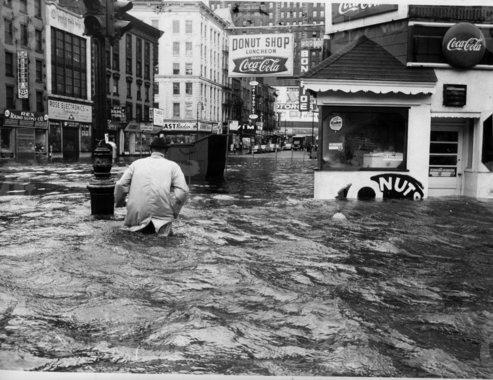
What about late-season hurricanes in New Jersey? Sandy must be the first one, right? Well, Hurricane Hazel landed on October 15th, 1954. And you may find much later ones. On December 2nd and 3rd, 1925, a hurricane brought 70 mph winds to Atlantic City. So calling Sandy "unprecedented" means to be ignorant about the history, sometimes very recent history. There's nothing unprecedented about hurricanes landing in New Jersey, not even about the subset that lands in October.
The journalists like to hype things because it brings them profit. Every time the end of the world arrives on the following morning, lots of newspapers are sold. But maybe they also partly want to "help the nation" and by making the stories more dramatic, they make the people more disciplined. I have some understanding for all these things. But I would be much happier to see something different as well – journalists as impartial messengers who actually describe what is happening, how people respond, and what their reasons are. A large fraction of the citizens are skeptical about the "catastrophic predictions" and many of them have decided not to evacuate their homes for reasons that are often rather sound. It would be nice if the journalists sometimes behaved as journalists in a free society – which means journalists who report and allow the readers and viewers to decide – and they were not trying to pretend that all these people are uneducated hacks and criminals and that the journalists' main holy duty is to strengthen the influence of the "authorities".
A hurricane lands somewhere in the U.S. almost every year and while it's good when the public cooperates with its representatives, it's simply unreasonable to consider all such situations "exceptional states of war" equivalent to "martial law" because we would be living under such "martial law" most of our lives (hurricanes are not the only reasons that may spark such "exceptional" measures).
I am not claiming that Sandy must turn out to be another non-event; I don't really know. The wind are strong enough so that you don't want to walk in the middle of your town. But it's rather plausible that it will be another non-event and it's wrong for the society to pretend it is not plausible, not even if this game is supposed to help a "good cause".
Saturday, October 27, 2012
Galileo's 1633 trial: a tragic hero
I was pleased that virtually all the media criticize the recent manslaughter verdict against the Italian seismologists.
Many outlets compare the trial to the 1633 trial against Galileo Galilei. So I decided to find a video explaining some details about that event in particular and Galileo's life in general – and the 52-minute Chicago talk by Rocky Kolb (whom I hosted once at Harvard) from 2011 turned out to be a very informative choice although I clearly disagree with many sentiments that Kolb expressed during the talk.
Some people say that Galileo has overreached, he was arrogant because throughout his life, he enjoyed to point out why idiots around him were idiots, and all this stuff.
Galileo wasn't arrogant when he explained that the difference between him and the stupid folks around him was greater than the difference between humans and animals. He wasn't arrogant because his statement was clearly true and very important. It was very important from the viewpoint of the abstract truth; it was very important for the civilized character of the present, too.
Off-topic: Decay: Something truly unexpected has been discovered at the LHC! By young Oxford employees at CERN.
At the beginning of the talk, Rocky Kolb tells us various things about Galileo's ability to get the maximum out of the telescope (that he "devised" but didn't invent – but he deliberately used the ambiguous verb "devised") and he describes other events from Galileo's CV.
Kolb says that astronomy had been a part of the mathematics (and not physics) departments because astronomers were only supposed to find "kinematic fits" for the observed trajectories but they were not trying to find the "physical or dynamical causes". And he reminds us that the Catholic Church hadn't had an official position on Copernicanism: they would say it's just some models that didn't say anything direct about the reality (they were agnostic in the disagreement between Ptolemy and Copernicus). Galileo's own effort to codify his understanding of the astronomy (he only became a Copernicanist at some point when he studied this problem at depth) is what forced the Church to adopt an official position (unfortunately, one chosen by theologians and incompetent astronomers according to a literal interpretation of the Bible) and to bring him into trouble and impose a sort of a ban of Copernicanism for him.
I am extremely grateful to Galileo for having done what he has done and he was just right about these scientific and political issues. Let me mention some of the aspects discussed by Kolb.
For example, Galileo was being implicitly criticized for claiming to be able to correctly interpret the astronomical statements in the Bible. Was he overreaching? I don't think so. Because Christianity was such a universal and omnipotent part of the culture of that epoch, it was virtually impossible to convince anyone of anything if you outright denied the tenets of Christianity such as "the validity of the Holy Scripture (at least in some sense)".
Another fact, and it is a related fact, was that the Church bureaucrats had a monopoly to "interpret the reality". Everyone else was doing just some "details" that were not allowed to influence any "greater questions". But Galileo Galilei clearly had the insights that were going to substantially change some "greater questions": he was giving birth to the scientific method as we know it and it is no detail.
Because of this reason, it seems totally obvious that he simply had to struggle to overtake the competency to determine what is true about the deepest cosmic questions from the Church bureaucrats. After all, as Kolb admits, Copernicus himself wrote just a cryptic text filled with complicated mathematical expressions and jargon that didn't even attempt to reach a broader readership, so his work became a hobby for a small group of astronomers only. Thank God, Galileo didn't want to be satisfied with a similar outcome. If he were satisfied, the Western civilization could be as unscientific and unenlightened in 2012 AD as the Islamic anticivilization is. The religious leaders could dictate what to think about the motion of celestial bodies – and all other fundamental enough questions – even today.
So the statement "I am able to properly interpret the biblical astronomy" was simply saying "I know how the things actually work" translated to the Latin of the time in which the "power to define the truth" and the "power of Church bureaucrats to preach" were considered synonymous. The Bible was considered true by definition, so of course that given this assumption, the ability to explain how the Solar System actually worked was the same thing as explaining how it worked according to the Bible.
For the very same reason, Galileo – who wanted to become a monk but (because of the pressure from his father) tried to become a physician for a while – ultimately grabbed the credentials as a mathematician as well as a philosopher. He realized that the "philosophers" of his time were just doing rubbish – and they were mostly parroting and uncritically celebrating folks like Aristotle which meant that there was almost no potential for genuine progress. At the same time, these deluded people had lots of influence so Galileo realized that he needed to be considered a philosopher as well in order to gain the capacity to correct many of the unscientific misconceptions that were spread by the "philosophers".
Much of this stuff that Galileo was doing was politics but Galileo was the good guy who actually possessed the truth.
In 1632, Galileo wrote The Dialogue Concerning the Two Chief World Systems. It is a fictitious discussion between Salviati, a hero named after Galileo's friend and presenting many of Galileo's positions, and Simplicio, a guy described as an idiot who presents the opinion of some stupid people of the time such as Ludovico delle Colombe (1565-1616?), Galileo's fiercest detractor, and Cesare Cremonini (1550–1631), a colleague who rejected all the observations based on telescopes as a matter of principle. And of course another stupid guy, the Pope (Urban VIII, reign 1623-1644). The discussion is moderated by a smart laymen called Sagredo who is neutral at the beginning.
Kolb says that "he had no idea" why Galileo would write a text in which an idiot looked like he was the Pope. Well, I have some idea. It's because this was exactly what was happening in the real world, too. The Pope was one of the idiots of Galileo's time and it was totally necessary for any progress to challenge this particular idiot, too. Again, I think that if Galileo hadn't had the courage to challenge the Pope, the Western civilization wouldn't really change and the scientific revolution couldn't begin because obsolete dogmas and their champions would continue to have the power to stifle any important scientific development.
Galileo's "Dialogue" quickly made it to the bestseller lists. At some moment, the book was banned. Of course, the book became even more popular because of that. Soon afterwards, the Pope complained to the Inquisition. In 1633, Galileo arrived for the trial to Rome (his clever attempt to relocate the trial to friendly Florence was denied). See a 5-minute cartoon version of the trial. Galileo faced a possibility of Giordano Bruno's fate – whose tongue was (after an 8-year-long trial) glued to the mouth so that the politically correct assholes of his time didn't have to worry that he would say something "dangerous" before he is burned at stake.
All the materials from the trial became publicly accessible – despite the obvious Catholic Church's efforts to keep them secret – thanks to Napoleon Bonaparte. He visited Rome and kindly asked them, with a minor help of this army, to hand out the materials so that they may be kept in Paris. ;-) In 1845, the French agreed to return all the materials to the Vatican but there was a condition: everything must be published.
But back to 1633. The Pope was the clear driver of attempts to harass Galileo. So the court was filled with Galileo's enemies. But what could have they accused him from? The book actually had signatures of several Catholic officials who authorized the book as OK for all audiences. So how could they punish him if they had allowed him to write it?
The trial was pretty short: about five pages. Four depositions. First one: Do you know why you're here, Dr Galileo? It's probably about my book. Do you recognize it etc.? Were you in Rome in 1616? Yes, I came to learn about the geocentrism vs heliocentrism debate. The Church had banned him from promoting heliocentrism, at least the possibly fake official documents suggest so. Galileo argued he didn't really remember what he wasn't allowed to do – defend, teach, study, promote, whatever. Galileo argued that he didn't even defend heliocentrism; instead, he was promoting both sides of the debate, including the imbeciles, mental pygmies, dumb idiots, people hardly deserving to be called human beings, people too stupid to recognize their own limitations (these are Galileo's actual words but yes, great minds think alike), in a fair and balanced way. But the Church said he wasn't allowed to teach it in any way.
To defend himself, Galileo said an incredible lie: he said that the book defended the geocentrists (called the "imbeciles" etc.). An attorney would probably stop him from making such an implausible claim but he was defending himself.
Next time, Galileo said that he suddenly understood why they were thinking he was defending Copernicanism. He actually was so smart and nice that he described the Copernican interpretation – so obviously wrong – in a way that actually looks much more plausible than it is. :-) He offered them to fix the things in another edition of the book.
Galileo got 8 days to prepare a defense. He said he didn't remember any ban on "teaching" heliocentrism. And he said he believed that he didn't have to inform the censors about the injunction. My only error was the ambition to appear smarter than everyone else, he said. And Galileo complained about his health, old age, and good name.
The Inquisition asked him a simple question: Had he ever been a Copernican? Galileo said he was uncertain until 1616 but since the official position was taken, he believed Ptolemy. Clearly a lie. He denied being Copernican. The Church said they didn't believe him.
On June 22nd, 1633, Galileo had to listen to the sentence in humiliating clothes. He's suspect of the heliocentric heresy, he was told. Galileo saved his life by a verbal self-destruction. There is no way how he could have said "it is moving, anyway" during this scene. The life in prison was signed by 7 of the 10 cardinals only. It's not clear to me whether the remaining 3 wanted a tougher or milder punishment, however. The Pope – who orchestrated the trial behind the scenes – later changed the verdict to a "life-long house arrest" in order to look magnanimous.
Galileo died in 1642. His remains were soon moved to a more prestigious place but as recently as in the 19th century, his "Dialogue" could imperil your immortal soul even if you just read it.
Kolb asks whether Galileo was a classical tragic hero. My answer is Yes, he was. But he was much more than that, too. He was a man who opened the doors to scholars' ability to challenge the opinions held by the entire hierarchy of Church bureaucrats (the Christian churches became able to reform themselves and compatible with the modern world as a result of that), who established the scientific method, and who was still able to save his life by a sequence of tricks and lies. His achievements included the highly technical and experimental ones, conceptual and theoretical ones, as well as political ones, and all these three groups were very important.
Friday, October 26, 2012
Anniversaries: Meitner, van Vleck, Mills, Bohm
If you're a famous physicist, you should be careful today: October 27th is a day when many famous physicists die. This very date turned out to be fatal for Lise Meitner in 1968, John Hasbrouck van Vleck in 1980, David Bohm in 1992 (twenty years ago), and Robert Mills in 1999.
They're known for the co-discovery of the nuclear fission; the van Vleck transformations, determinant, paramagnetism, and other insights about quantum mechanics applied to solids; Aharonov-Bohm effect and the revival of the misguided pilot wave theory by Louis de Broglie; and Yang-Mills theory, respectively.
You may see it's way too many people and way too many topics to discuss.
I already wrote a similar, perhaps complementary, text about her in 2008 but because the lady had such trustworthy initials :-), let me offer you another one so that you may compare.
Lise Meitner was born to a Jewish family in Vienna on November 7th, 1878 (her birthday would later be known as the Great October Socialist Revolution anniversary, proving that leftists prefer communist assholes such as Lenin over great scientists such as Meitner).
 In Spring 2011, I watched a program on her fascinating life when I was a jury member at the Academic Film Festival in Olomouc. She faced all kinds of difficulties that would be enough for a strong man. At the same moment, even this very movie convinced me that most of the harassment she has experienced throughout her life had very little to do with her being a woman.
It was mostly about her being Jewish, her bad luck – but she was lucky in many other respects. Not everyone lives for 90 years, for example (that's true despite her heart attack that occurred in 1964). The Jewish girl converted to (Lutheran) Christianity as an adult which is kind of cute but the Nazis didn't pay much attention to this fact even though Meitner herself apparently considered herself a loyal citizen of Germany and perhaps a Christian role model, too. And she actually inherited her detachment from the Jewish identity from her ancestors: it has had quite some roots in her family.
Ludwig Boltzmann, a great statistical mechanic and a forefather of quantum mechanics, was her teacher. She got a PhD in 1905 for "Heat conduction by inhomogenous bodies" (in German) and she was actually not the first woman but the second woman who got a physics PhD over there. Women would be officially discouraged from studying such things a century ago. At the same moment, it seems to me that almost every woman who got the desire as well as talent to become a physicist managed to find a loophole or exception of a sort.
Off-topic: I usually embed this snowy music video on TRF when the first snow of the second half of each year arrives to Pilsen. It's usually but not always at the end of the October and 2012 confirms the approximate rule: the snow is here again. ;-) See a photo gallery.
She rejected an offer to work in a factory and, with some financial backing, boldly went to Berlin and attended Max Planck's lectures – the first woman who was allowed to be there which may sound bad but on the other hand, it also shows that there were no unbreakable barriers imposed by leaders of physics such as Boltzmann and Planck.
Meitner would become Planck's assistant and work with Otto Hahn on radioactive isotopes and beta-decay. She got some medals in Berlin, earned her own lab by 1917, and independently discovered the Auger effect (it is a bit surprising that it still hasn't been renamed as Auger-Meitner effect). In 1926, she became a full professor, and did work that was essential for the discovery of the nuclear fission in 1939.
At that time, however, this "Marie Curie of Germany" as Einstein called her was already in emigration so she wasn't physically present during the final moments of the discovery of nuclear fission. I guess that many people would agree that this fact itself was a sufficient explanation why she didn't share the 1944 Chemistry Nobel Prize for nuclear fission. In some sense, I am more surprised that in 1944, they would still count such nuclear physics things as "chemistry". It sounds stupid.
In 1933, when Hitler came to power, she was actually a director. As a Jew, she was under a clear threat that she denied in front of herself, despite the terror against her fellow Jewish physicists. She continued to work, being partly protected by her Austrian citizenship. This citizenship became worthless with the Anschluss – when Austria was annexed – and she managed to change her identity and escape Germany with 10 marks in her wallet and a diamond ring ready to be paid to border guards (which wasn't necessary).
From the Netherlands, she was able to escape to Sweden and she was able to quickly become the boss of a physics lab in Stockholm. Despite all the comments about "prejudices against women" that were everywhere, I think it is extremely hard to find some tangible evidence of these claims in the actual events that were directing her career.
She continued to communicate with Otto Hahn and she was also meeting Niels Bohr. She was actually the first person in the world to realize the concept of "chain reaction", the reason why \(E=mc^2\) explained the energy released by the reactions, the main contributor to the discovery of transuranium elements, and so on. I have no doubts that from a broader perspective, she's been a stellar physicist who deserved a Nobel prize. However, she's far from being the only one in this category who wasn't given one, for various reasons: there are tons of men in this category, too. So when I evaluate her life, I would say that there was almost no genuine substantial "discrimination" against women even a century ago.
 John Hasbrouck Van Vleck who shared the 1977 Physics Nobel Prize with Phil Anderson and Nevill Francis Mott was born in Connecticut in 1899. His father and grandfather were a mathematician and astronomer, respectively. He studied in Wisconsin, at Harvard, worked in Minnesota, and then at Harvard again.
He is considered the father of modern magnetism as he pioneered the quantum mechanical description of magnetism, especially paramagnetism, as well as the chemical bonding in metal complexes and crystals. He worked on radars during the Second World War and he would understand lots of things about the absorption of centimeter-or-so microwaves by molecules. That was important not only for the military but also for the later birth of radioastronomy. During the Manhattan project, he would help to reduce the size of the Little Boy's firing gun.
The van Vleck determinant is known to theorists as the determinant of an infinitely large matrix, the operator \(\omega^2+U''\), whose power appears as a normalization prefactor if you're trying to solve various quantum mechanical problems exactly (e.g. the harmonic oscillator in the path integral language).
 I wrote a long text about David Bohm in 2007. It was followed by lots of texts explaining why his "interpretation" is based on a deep misunderstanding of how the quantum mechanical phenomena work.
There's already too much Bohm-related material on this blog so I won't add additional paragraphs now.
 Robert Mills of the Yang-Mills fame was born in New Jersey in 1927. He studied at Columbia from 1944 and won the Putnam Competition in 1948. He earned a degree in Cambridge, spent some time at the IAS, and worked in Ohio.
Of course, the 1954 discovery of the Yang-Mills equations – when these men shared an office in Brookhaven – is his most famous achievement but he actually also studied many-body theory and the theory of alloys. I would say that Oskar Klein knew a "large part" of the spirit behind the Yang-Mills theories back in the 1930s.
Even though the Yang-Mills equations were a bit isolated "superhit" of Robert Mills, all these people were ahead of time, however. Only in the mid 1960s or so, it became meaningful to build realistic models of particle physics that depended on non-Abelian gauge theories. At that time, people wouldn't study proposed theories too carefully unless they were confident that they described the actual Universe around us. We're no longer this narrow-minded today – it's hard to find the experimental evidence revealing some completely new phenomena which is why theorists inevitably have to think about models well before their effects manifests themselves empirically – so it's somewh`t unlikely that the right and relevant equations would remain unnoticed and understudied for many decades. But maybe it could happen again.
He died in 1999.
They're known for the co-discovery of the nuclear fission; the van Vleck transformations, determinant, paramagnetism, and other insights about quantum mechanics applied to solids; Aharonov-Bohm effect and the revival of the misguided pilot wave theory by Louis de Broglie; and Yang-Mills theory, respectively.
You may see it's way too many people and way too many topics to discuss.
I already wrote a similar, perhaps complementary, text about her in 2008 but because the lady had such trustworthy initials :-), let me offer you another one so that you may compare.
Lise Meitner was born to a Jewish family in Vienna on November 7th, 1878 (her birthday would later be known as the Great October Socialist Revolution anniversary, proving that leftists prefer communist assholes such as Lenin over great scientists such as Meitner).
In Spring 2011, I watched a program on her fascinating life when I was a jury member at the Academic Film Festival in Olomouc. She faced all kinds of difficulties that would be enough for a strong man. At the same moment, even this very movie convinced me that most of the harassment she has experienced throughout her life had very little to do with her being a woman. It was mostly about her being Jewish, her bad luck – but she was lucky in many other respects. Not everyone lives for 90 years, for example (that's true despite her heart attack that occurred in 1964). The Jewish girl converted to (Lutheran) Christianity as an adult which is kind of cute but the Nazis didn't pay much attention to this fact even though Meitner herself apparently considered herself a loyal citizen of Germany and perhaps a Christian role model, too. And she actually inherited her detachment from the Jewish identity from her ancestors: it has had quite some roots in her family.
Ludwig Boltzmann, a great statistical mechanic and a forefather of quantum mechanics, was her teacher. She got a PhD in 1905 for "Heat conduction by inhomogenous bodies" (in German) and she was actually not the first woman but the second woman who got a physics PhD over there. Women would be officially discouraged from studying such things a century ago. At the same moment, it seems to me that almost every woman who got the desire as well as talent to become a physicist managed to find a loophole or exception of a sort.
Off-topic: I usually embed this snowy music video on TRF when the first snow of the second half of each year arrives to Pilsen. It's usually but not always at the end of the October and 2012 confirms the approximate rule: the snow is here again. ;-) See a photo gallery.
She rejected an offer to work in a factory and, with some financial backing, boldly went to Berlin and attended Max Planck's lectures – the first woman who was allowed to be there which may sound bad but on the other hand, it also shows that there were no unbreakable barriers imposed by leaders of physics such as Boltzmann and Planck.
Meitner would become Planck's assistant and work with Otto Hahn on radioactive isotopes and beta-decay. She got some medals in Berlin, earned her own lab by 1917, and independently discovered the Auger effect (it is a bit surprising that it still hasn't been renamed as Auger-Meitner effect). In 1926, she became a full professor, and did work that was essential for the discovery of the nuclear fission in 1939.
At that time, however, this "Marie Curie of Germany" as Einstein called her was already in emigration so she wasn't physically present during the final moments of the discovery of nuclear fission. I guess that many people would agree that this fact itself was a sufficient explanation why she didn't share the 1944 Chemistry Nobel Prize for nuclear fission. In some sense, I am more surprised that in 1944, they would still count such nuclear physics things as "chemistry". It sounds stupid.
In 1933, when Hitler came to power, she was actually a director. As a Jew, she was under a clear threat that she denied in front of herself, despite the terror against her fellow Jewish physicists. She continued to work, being partly protected by her Austrian citizenship. This citizenship became worthless with the Anschluss – when Austria was annexed – and she managed to change her identity and escape Germany with 10 marks in her wallet and a diamond ring ready to be paid to border guards (which wasn't necessary).
From the Netherlands, she was able to escape to Sweden and she was able to quickly become the boss of a physics lab in Stockholm. Despite all the comments about "prejudices against women" that were everywhere, I think it is extremely hard to find some tangible evidence of these claims in the actual events that were directing her career.
She continued to communicate with Otto Hahn and she was also meeting Niels Bohr. She was actually the first person in the world to realize the concept of "chain reaction", the reason why \(E=mc^2\) explained the energy released by the reactions, the main contributor to the discovery of transuranium elements, and so on. I have no doubts that from a broader perspective, she's been a stellar physicist who deserved a Nobel prize. However, she's far from being the only one in this category who wasn't given one, for various reasons: there are tons of men in this category, too. So when I evaluate her life, I would say that there was almost no genuine substantial "discrimination" against women even a century ago.
John Hasbrouck Van Vleck who shared the 1977 Physics Nobel Prize with Phil Anderson and Nevill Francis Mott was born in Connecticut in 1899. His father and grandfather were a mathematician and astronomer, respectively. He studied in Wisconsin, at Harvard, worked in Minnesota, and then at Harvard again.He is considered the father of modern magnetism as he pioneered the quantum mechanical description of magnetism, especially paramagnetism, as well as the chemical bonding in metal complexes and crystals. He worked on radars during the Second World War and he would understand lots of things about the absorption of centimeter-or-so microwaves by molecules. That was important not only for the military but also for the later birth of radioastronomy. During the Manhattan project, he would help to reduce the size of the Little Boy's firing gun.
The van Vleck determinant is known to theorists as the determinant of an infinitely large matrix, the operator \(\omega^2+U''\), whose power appears as a normalization prefactor if you're trying to solve various quantum mechanical problems exactly (e.g. the harmonic oscillator in the path integral language).
I wrote a long text about David Bohm in 2007. It was followed by lots of texts explaining why his "interpretation" is based on a deep misunderstanding of how the quantum mechanical phenomena work. There's already too much Bohm-related material on this blog so I won't add additional paragraphs now.
Robert Mills of the Yang-Mills fame was born in New Jersey in 1927. He studied at Columbia from 1944 and won the Putnam Competition in 1948. He earned a degree in Cambridge, spent some time at the IAS, and worked in Ohio. Of course, the 1954 discovery of the Yang-Mills equations – when these men shared an office in Brookhaven – is his most famous achievement but he actually also studied many-body theory and the theory of alloys. I would say that Oskar Klein knew a "large part" of the spirit behind the Yang-Mills theories back in the 1930s.
Even though the Yang-Mills equations were a bit isolated "superhit" of Robert Mills, all these people were ahead of time, however. Only in the mid 1960s or so, it became meaningful to build realistic models of particle physics that depended on non-Abelian gauge theories. At that time, people wouldn't study proposed theories too carefully unless they were confident that they described the actual Universe around us. We're no longer this narrow-minded today – it's hard to find the experimental evidence revealing some completely new phenomena which is why theorists inevitably have to think about models well before their effects manifests themselves empirically – so it's somewh`t unlikely that the right and relevant equations would remain unnoticed and understudied for many decades. But maybe it could happen again.
He died in 1999.
The holographic principle
The newest episode of The Big Bang Theory that was aired last night was called "The Holographic Excitation" (S06E05).
It's pretty cool that a TV sitcom manages not only to show a hologram but Leonard Hofstadter was even allowed to present a rather accurate definition of the holographic principle in quantum gravity i.e. string theory (you won't find it in any popular science TV program that claims to explain modern physics!). And as a result, he was able to have an intercourse with Penny right after she wore some glasses and was shown a moving holographic pencil and a moving holographic globe. (Later, he repeated the same achievement using Maglev.)
(And I even think that Prof Nina Byers whom I know rather well walks behind the main actors around 9:15. This theory seems to make sense because she's at UCLA, much like the TBBT science adviser David Saltzberg.)
The holographic principle of quantum gravity is an incredible example of the ability of the quantum gravity and string theory research to teach us things we really didn't and perhaps couldn't anticipate, force us to modify or abandon some prejudices, and adopt ideas about the unification of ideas and concepts that philosophers couldn't have invented after thousands of years of disciplined reasoning but physicists may be forced to realize them if they carefully follow the mathematical arguments sprinkling from a theory that they randomly discovered in a cave.
But let's return half a century into the past. Holography started in "everyday life physics" in the late 1940s.
So let us begin with this exercise in wave optics that has nothing to do with quantum gravity or string theory so far – but you will see that it exhibits a similar mechanism that is apparently "recycled" by the laws of quantum gravity.
Dennis Gabor's 3D images
Hungarian-British physicist Dennis Gabor was playing with X-ray microscopy and invented a new technology that is rather cute. One may create two-dimensional patterns on a piece of film which, when illuminated by a laser, create the illusion of a three-dimensional object floating in the space around it. I saw my first hologram sometime in 1985 – it was a Soviet one, the mascot of the 1980 Olympics in Moscow – in the National Technological Museum in Prague where we went to a school excursion. I couldn't believe my eyes. :-)
The basic setup involves a monochromatic laser beam, some interference, and a photographic plate. First, we must create the hologram – a film with strip-like patterns that don't resemble the bear at all but which allow the bear to jump out once you use another laser. Fine. Let's create a hologram.

You see that a monochromatic (one sharp frequency) laser beam is coming from the upper left corner. Each photon's wave function gets divided into two portions by a beam splitter – note that the wave function has a probabilistic interpretation for one particle but if many photons are in the same state, it may be interpreted as a classical field.
Two parts of the wave are moving from the beamsplitter. One gets reflected from a simple mirror. More interestingly, the other one gets reflected from the object we want to see on the hologram. They interfere – these waves are recombined – in the right lower corner and they create a system of interference strips on the photographic plate.
We have created a hologram and now we may sell it. What will the buyers do with it?

This interference pattern may be shined upon by a "reconstruction beam" of the same frequency and what we see is a virtual image behind the plate. You may actually move your head and eyes and the position of all points on the image are moving just like if the virtual image were a real object. So it's not just a stereographic image offering two different pictures for the two eyes: the hologram is ready to provide the right electromagnetic field regardless of the direction from which you observe it! If you want to see the right face of the object, you move your head to the right side, and so on.
Why does it work? It's very useful to think about the hologram for a simple object, e.g. a point at a given distance. The total wave function on the photographic plate parameterized by coordinates \(x,y\) is given by \(U_O + U_R\) where \(U_O\) is the complicated wave reflected from the object and \(U_R\) is the simple reference beam reflected from the plain mirror.
You may imagine that for an object being a point, \(U_R=1\) and \(U_O(x,y)=\exp(iks(x,y))\) where \(s\) is the distance between the point (the real object we want to holographically photograph) and the given point \((x,y)\) on the photographic plate. The wave number is of course the inverse wavelength, \(k=2\pi/\lambda\). The sum \(U_R+U_O\) gives you some simple concentric circles (with decreasing distances between neighbors) around the point on the plate that is closest to the photographed point. Fine. The total intensity – how much the point on the film changes the color – is given by \[
T \sim \abs{U_O}^2 + \abs{U_R}^2 + U_R^* U_O + U_O^* U_R.
\] I omitted an unimportant overall normalization and used the symbol \(T\) for this quantity because the darkness of the point of the film will be interpreted as the transmittance, the ability of the place of the hologram to transmit the other, reconstruction beam when we actually want to reconstruct the image.
For a simple explanation why you will see the reconstructed virtual image, assume that the reference beam \(U_R\) is much stronger than the object-induced wave \(U_O\) i.e. \(U_R\gg U_O\). So the total wave function may be written as \[
U = 1 + \varepsilon \exp(iks)
\] where \(\varepsilon\) is small, \(\varepsilon\ll 1\). You see that the squared absolute value is\[
T \sim |U|^2 = 1 + \varepsilon \exp(iks) + \varepsilon \exp(-iks) + {\mathcal O}(\varepsilon^2).
\] Imagine that this transmittance is just multiplying another simple reference beam \(U_R\to T \cdot U_R\) and produces some electromagnetic field in the vicinity of the hologram. For the sake of simplicity, assume \(U_R=1\) again. It's only \(U_O\) that carries the "complicated information about the photographed object" but we still need some nonzero \(U_R\).
You may see that \(T\) is almost the same thing as \(U\) except that it has an extra, complex conjugate term. So the electromagnetic field in front of the hologram (on the side with the air) will be the same field as the electromagnetic field we used to have when there was a real object in front of the hologram plus some complex conjugate term. One of these terms creates a nice virtual image behind the plate because it has a similar mathematical structure and when the fields have the same values, we see the same thing.
The other term induces the feeling of another copy of the object – a real image. It's because all the waves should also be multiplied by the universal time-dependent factor \(\exp(-i\omega t)\) (before you interpret the real and imaginary value of the overall sum as the electric and magnetic fields, respectively, kind of) and the complex conjugation is equivalent to \(t\to -t\) which means that the wave is kind of moving backwards in time which is effectively equivalent to moving from the other side of the mirror.
So when you look at the hologram, you actually see one virtual image behind the plate and one real image in front of the plate (which may overlap with your head). I don't want to figure out which term is which because odds would be close to 50% that my answer would be wrong. To be sure about the answer to this not-so-critical question, I would have to decompose the electromagnetic wave to the electric and magnetic components, consider \(x\) and \(y\) polarizations, be careful about the spatial dependence and all the signs, etc. But things clearly work up to this "which is which" question that I am not too interested in.
In this brute calculation, I have neglected the \({\mathcal O}(\varepsilon^2)\) terms which indicates that the hologram will be badly perturbed if \(\varepsilon\sim {\mathcal O}(1)\) but a more accurate analysis shows that the result won't be too bad even if you include these second-order terms. At any rate, I have created a virtual image of a point! By the superposition principle, you are allowed to envision any object to be composed of many points (perhaps as an "integral of them") and add the terms \(\exp(iks_P)\) from each point \(P\) and you get the idea how it work for a general object.
There exist generalizations – colorful holograms, perhaps moving holograms and holographic TV, and so on, but I don't want to go into these topics on the boundary of physics and engineering. Everyone knows that holograms are cool. What's important for us is that they store much more than some two-dimensional projections of a 3D object as seen from one direction or two directions; they store the information about the 3D object as seen from any direction (in an interval). They're the whole thing.
Instead of discussing advanced topics of holography in wave optics, we want to switch to the real topic, the holographic principle in quantum gravity.
The holographic principle
In the research of quantum gravity, the notion of holography was introduced by somewhat speculative but highly playful papers by Gerard 't Hooft in 1993 and Lenny Susskind in 1994. Charles Thorn is mentioned as having suspected similar ideas for years.
It may sound unusual ;-) but Lenny Susskind's paper was the technically more detailed one, getting well beyond the hot philosophical buzzwords. Susskind also suppressed some unjustified and unjustifiable "digital" comments by 't Hooft who had written that the information had to be encoded in binary digits (bits). Of course, there's no reason whatsoever why it couldn't be trinary digits, other digits, or – much more likely – (for humans and computers) some much less readable but more natural codes.
What's the basic logic behind holography in quantum gravity?
In classical general relativity, a black hole is the final stage of the collapse of a star or another massive object. Because the entropy never decreases, as the second law of thermodynamics demands, the "final stage" must also be the stage with the maximum entropy. So the black hole has the highest entropy among all bound or localized objects of the same mass (and the same values of charges and the angular momentum). I emphasize the adjectives "bound or localized" because delocalized arrangements of particles with a given total energy – e.g. the Hawking radiation resulting from a black hole that has already evaporated – may carry a higher entropy (that's inevitably the case because the process of Hawking radiation must be increasing the total entropy, too).
But we've known from the insights by Jacob Bekenstein and Stephen Hawking in the 1970s that the black hole entropy is\[
S_{BH} = \frac{A}{4G}
\] in the relativistic \(c=\hbar=1\) units. It's one-quarter of the area of the event horizon \(A\) in the units of the Planck area. In normal units, you must replace\[
G \to l_{\rm Planck}^2 \equiv \frac{G\hbar}{c^3}.
\] So the maximum entropy of a bound localized object of a given mass is actually given by the area of the black hole of the same mass. Because you can't really squeeze the matter into higher densities than the black hole, the black hole is also the "smallest object" that may contain the given mass.
To summarize, we see that the black hole is the "highest entropy" object as well as the "geometrically smallest" object among localized or bound objects of the given mass. It follows that it also maximizes the "entropy density" (entropy per unit volume) among the localized arrangement of matter of the same total mass. But the entropy carried by a black hole is only proportional to the surface area in the Planck units, \({\mathcal O}(R^2)\), so the entropy density per unit volume – the latter scales as \({\mathcal O}(R^3)\) – is therefore going to zero for large black holes i.e. for large masses or large regions.
The maximum density of entropy or information you may achieve with a given mass is actually going to zero if the mass is sent to infinity. If you try to squeeze too many memory chips into your warehouse, they will start to be heavy at some point and will gravitationally collapse and create a black hole which will have a certain radius – either smaller than or larger than your warehouse. At any rate, this black hole will only be able to carry \(1/4\) of a nat (a bit is \(\ln(2)\) nats) of information per unit surface area (by the surface, I mean the event horizon).
We see that the maximum information is carried by a constant density per unit area rather than the unit volume. You should appreciate how shocking it is. In some sense, it was completely unexpected by virtually all experts in the field. Quantum field theories predict some new phenomena at a characteristic distance scale. For example, Quantum Chromodynamics (QCD) says that quarks like to bind themselves into bound states where their distance is comparable to the QCD length scale, about one fermi or \(10^{-15}\) meters. So by the dimensional analysis, the only sensible "density of information" we may get in QCD is "approximately one bit per cubic fermi" or per "volume of the proton".
People would expect a similar thing in any QFT – which was mostly right – but they thought it would also hold in quantum gravity. So quantum gravity may achieve "one bit per Planck volume". But that was wrong. You see that the previous paragraph assumed a bit more than the dimensional analysis: it also implicitly and uncritically postulated that the information is proportional to the volume. This assumption followed from locality. But this assumption breaks down in quantum gravity where the information only scales as the surface area.
Because the "proportionality to the volume" is linked to "locality" – each unit volume is independent from others – the violation of the "proportionality of the information to the volume" that the holographic principle forces upon us also means that locality is violated, at least to some extent. And indeed, this violation of the locality is a fact responsible for the resolution of other puzzling questions in quantum gravity, too. In particular, some tiny and hard to observe but nevertheless real non-locality occurs during the evaporation of the black hole which is why the information may get from the black hole interior to infinity, after all – even though classical general relativity strictly prohibits such an acausal export of the information (locally, it's equivalent to the superluminal transport of information which was already banned in special relativity). In quantum gravity, this "ban" is softened because the information may temporarily violate the rule in analogy with the quantum tunneling. In fact, the black hole evaporation is a version of quantum tunneling.
Whether the holographic principle was real and what it exactly it meant and what it didn't mean remained a somewhat open question for 3 more years or so. However, at the end of 1997, Juan Maldacena presented his AdS/CFT correspondence which is a set of totally controllable mathematical frameworks in which holography holds. The information about a region – namely the whole anti de Sitter space – is stored at the boundary of the region – which is the asymptotic region at infinity which nevertheless looks like a "finite surface of a cylindrical Penrose diagram" if you use the language of Penrose causal diagrams.
The holographic principle surely captures the right "spirit" of quantum gravity but it is a bit vague. The AdS/CFT correspondence is a totally well-defined "refinement" of the holographic principle but it is arguably too special. Nevertheless, one must be careful about deriving potentially invalid corollaries of the holographic principle in other contexts.
For example, if you replace the anti de Sitter space by a finite-volume region of ordinary space, it seems clear to me that the holographic principle will only be true in some rather modest sense: it will be true that the entropy bounds hold. You can't squeeze too much entropy into a given region. However, if you will try to find the "theory on the boundary" that is equivalent to the evolution inside the region, you will find out that such a theory on the boundary "exists" – but the existence of such a theory is just an awkward translation of the ordinary evolution to some artificial degrees of freedom that you placed on the boundary.
What is special about the AdS/CFT correspondence is that the theory on the boundary is a theory of a completely normal type – namely a perfectly local, conformal quantum field theory. In fact, the boundary theory is more local than the gravitational theory in the bulk – because we just said that the gravitating theory in the bulk must be somewhat non-local. I am confident this fact depends on the infinite warp factor of the AdS space at infinity and won't hold for finite regions. In other words, I think that the "holographic theory living on a boundary" of a generic finite region won't be local in any sense – the boundary still has a preferred length scale, the Planck length, and other things so it is surely not conformal etc. And because it won't be local, it won't be simple or useful, either.
So one shouldn't generalize the holographic principle as seen in the AdS/CFT correspondence too far and too naively.
Lessons
In the 1970s, people got used to Ken Wilson's "Renormalization Group" inspired thinking about all effective field theories. Each theory predicted some phenomena at a characteristic length scale. The third power of the length scale gave us a characteristic volume. And one could expect roughly one nat (or bit) per one characteristic volume. It was nice, it made sense, it has lots of applications.
But Nature sometimes has surprises in store and quantum gravity had one, too. You may still use almost the same logic – one nat per unit region – but the region must actually be measured by its surface area, not its volume. So quantum gravity tells us that one of the spatial dimensions may be thought of as an "artificial" or "emergent" one and other mechanisms supporting this general paradigm have appeared as well.
A brutally arrogant yet extremely limited physicist who really sucks – think of Lee Smolin, for example – may think that he has all the right ideas how the final theory should look like from the beginning. Except that none of them works (except as tools to impress some stupid laymen). But other physicists who are much smarter but much more modest may see that all Smolin's prejudices are just wrong and Nature's inner organization is much more clever, creative, surprising, and forcing us to learn new concepts and new way of thinking more often than Smolin and many others would expect. One must still be ingenious or semi-ingenious to discover some important wisdom about Nature – e.g. holography and the AdS/CFT correspondence – but Nature just doesn't appreciate men who try to paint themselves as wiser than herself. Science is the process of convergence towards Her great wisdom; it is not a pissing contest in which idiots such as Lee Smolin try to pretend that they're smarter than Nature.
The story of the holographic principle also shows us that Nature recycles many ideas. The fields defined on the boundary CFT in the AdS/CFT correspondence literally emulate the waves \(U\) and \(T\) that I mentioned in the discussion of the "ordinary" holography by Dennis Gabor.
And the story of the holographic principle is another anecdotal piece of evidence in favor of the assertion that string/M-theory contains all the good ideas in physics. 't Hooft and Susskind, building on the work by Bekenstein, Hawking, and others, had some "feelings" about the right theory of quantum gravity and there had to be something right about them. And indeed, string theory showed us that they were mostly right. Because string theory is a much more mathematically well-defined a structure than "quantum gravity without adjectives", it also allowed us to convert the philosophical speculations into sharp and rigorous mathematical structures and equations and decide which of the philosophical speculations may be proven as meaningful ones and which can't.
The holographic principle is also another step in the evolution of physics that makes our theories "increasingly more quantum mechanical". While the spacetime remains continuous, we see that the information in a region may be bounded in unexpected ways and a whole dimension of space may be emergent. Needless to say, the equivalence between theories that disagree about the number of spacetime dimensions is only possible if you take the effects of quantum mechanics into account.
It's pretty cool that a TV sitcom manages not only to show a hologram but Leonard Hofstadter was even allowed to present a rather accurate definition of the holographic principle in quantum gravity i.e. string theory (you won't find it in any popular science TV program that claims to explain modern physics!). And as a result, he was able to have an intercourse with Penny right after she wore some glasses and was shown a moving holographic pencil and a moving holographic globe. (Later, he repeated the same achievement using Maglev.)
(And I even think that Prof Nina Byers whom I know rather well walks behind the main actors around 9:15. This theory seems to make sense because she's at UCLA, much like the TBBT science adviser David Saltzberg.)
The holographic principle of quantum gravity is an incredible example of the ability of the quantum gravity and string theory research to teach us things we really didn't and perhaps couldn't anticipate, force us to modify or abandon some prejudices, and adopt ideas about the unification of ideas and concepts that philosophers couldn't have invented after thousands of years of disciplined reasoning but physicists may be forced to realize them if they carefully follow the mathematical arguments sprinkling from a theory that they randomly discovered in a cave.
But let's return half a century into the past. Holography started in "everyday life physics" in the late 1940s.
So let us begin with this exercise in wave optics that has nothing to do with quantum gravity or string theory so far – but you will see that it exhibits a similar mechanism that is apparently "recycled" by the laws of quantum gravity.
Dennis Gabor's 3D images
Hungarian-British physicist Dennis Gabor was playing with X-ray microscopy and invented a new technology that is rather cute. One may create two-dimensional patterns on a piece of film which, when illuminated by a laser, create the illusion of a three-dimensional object floating in the space around it. I saw my first hologram sometime in 1985 – it was a Soviet one, the mascot of the 1980 Olympics in Moscow – in the National Technological Museum in Prague where we went to a school excursion. I couldn't believe my eyes. :-)
The basic setup involves a monochromatic laser beam, some interference, and a photographic plate. First, we must create the hologram – a film with strip-like patterns that don't resemble the bear at all but which allow the bear to jump out once you use another laser. Fine. Let's create a hologram.
You see that a monochromatic (one sharp frequency) laser beam is coming from the upper left corner. Each photon's wave function gets divided into two portions by a beam splitter – note that the wave function has a probabilistic interpretation for one particle but if many photons are in the same state, it may be interpreted as a classical field.
Two parts of the wave are moving from the beamsplitter. One gets reflected from a simple mirror. More interestingly, the other one gets reflected from the object we want to see on the hologram. They interfere – these waves are recombined – in the right lower corner and they create a system of interference strips on the photographic plate.
We have created a hologram and now we may sell it. What will the buyers do with it?
This interference pattern may be shined upon by a "reconstruction beam" of the same frequency and what we see is a virtual image behind the plate. You may actually move your head and eyes and the position of all points on the image are moving just like if the virtual image were a real object. So it's not just a stereographic image offering two different pictures for the two eyes: the hologram is ready to provide the right electromagnetic field regardless of the direction from which you observe it! If you want to see the right face of the object, you move your head to the right side, and so on.
Why does it work? It's very useful to think about the hologram for a simple object, e.g. a point at a given distance. The total wave function on the photographic plate parameterized by coordinates \(x,y\) is given by \(U_O + U_R\) where \(U_O\) is the complicated wave reflected from the object and \(U_R\) is the simple reference beam reflected from the plain mirror.
You may imagine that for an object being a point, \(U_R=1\) and \(U_O(x,y)=\exp(iks(x,y))\) where \(s\) is the distance between the point (the real object we want to holographically photograph) and the given point \((x,y)\) on the photographic plate. The wave number is of course the inverse wavelength, \(k=2\pi/\lambda\). The sum \(U_R+U_O\) gives you some simple concentric circles (with decreasing distances between neighbors) around the point on the plate that is closest to the photographed point. Fine. The total intensity – how much the point on the film changes the color – is given by \[
T \sim \abs{U_O}^2 + \abs{U_R}^2 + U_R^* U_O + U_O^* U_R.
\] I omitted an unimportant overall normalization and used the symbol \(T\) for this quantity because the darkness of the point of the film will be interpreted as the transmittance, the ability of the place of the hologram to transmit the other, reconstruction beam when we actually want to reconstruct the image.
For a simple explanation why you will see the reconstructed virtual image, assume that the reference beam \(U_R\) is much stronger than the object-induced wave \(U_O\) i.e. \(U_R\gg U_O\). So the total wave function may be written as \[
U = 1 + \varepsilon \exp(iks)
\] where \(\varepsilon\) is small, \(\varepsilon\ll 1\). You see that the squared absolute value is\[
T \sim |U|^2 = 1 + \varepsilon \exp(iks) + \varepsilon \exp(-iks) + {\mathcal O}(\varepsilon^2).
\] Imagine that this transmittance is just multiplying another simple reference beam \(U_R\to T \cdot U_R\) and produces some electromagnetic field in the vicinity of the hologram. For the sake of simplicity, assume \(U_R=1\) again. It's only \(U_O\) that carries the "complicated information about the photographed object" but we still need some nonzero \(U_R\).
You may see that \(T\) is almost the same thing as \(U\) except that it has an extra, complex conjugate term. So the electromagnetic field in front of the hologram (on the side with the air) will be the same field as the electromagnetic field we used to have when there was a real object in front of the hologram plus some complex conjugate term. One of these terms creates a nice virtual image behind the plate because it has a similar mathematical structure and when the fields have the same values, we see the same thing.
The other term induces the feeling of another copy of the object – a real image. It's because all the waves should also be multiplied by the universal time-dependent factor \(\exp(-i\omega t)\) (before you interpret the real and imaginary value of the overall sum as the electric and magnetic fields, respectively, kind of) and the complex conjugation is equivalent to \(t\to -t\) which means that the wave is kind of moving backwards in time which is effectively equivalent to moving from the other side of the mirror.
So when you look at the hologram, you actually see one virtual image behind the plate and one real image in front of the plate (which may overlap with your head). I don't want to figure out which term is which because odds would be close to 50% that my answer would be wrong. To be sure about the answer to this not-so-critical question, I would have to decompose the electromagnetic wave to the electric and magnetic components, consider \(x\) and \(y\) polarizations, be careful about the spatial dependence and all the signs, etc. But things clearly work up to this "which is which" question that I am not too interested in.
In this brute calculation, I have neglected the \({\mathcal O}(\varepsilon^2)\) terms which indicates that the hologram will be badly perturbed if \(\varepsilon\sim {\mathcal O}(1)\) but a more accurate analysis shows that the result won't be too bad even if you include these second-order terms. At any rate, I have created a virtual image of a point! By the superposition principle, you are allowed to envision any object to be composed of many points (perhaps as an "integral of them") and add the terms \(\exp(iks_P)\) from each point \(P\) and you get the idea how it work for a general object.
There exist generalizations – colorful holograms, perhaps moving holograms and holographic TV, and so on, but I don't want to go into these topics on the boundary of physics and engineering. Everyone knows that holograms are cool. What's important for us is that they store much more than some two-dimensional projections of a 3D object as seen from one direction or two directions; they store the information about the 3D object as seen from any direction (in an interval). They're the whole thing.
Instead of discussing advanced topics of holography in wave optics, we want to switch to the real topic, the holographic principle in quantum gravity.
The holographic principle
In the research of quantum gravity, the notion of holography was introduced by somewhat speculative but highly playful papers by Gerard 't Hooft in 1993 and Lenny Susskind in 1994. Charles Thorn is mentioned as having suspected similar ideas for years.
It may sound unusual ;-) but Lenny Susskind's paper was the technically more detailed one, getting well beyond the hot philosophical buzzwords. Susskind also suppressed some unjustified and unjustifiable "digital" comments by 't Hooft who had written that the information had to be encoded in binary digits (bits). Of course, there's no reason whatsoever why it couldn't be trinary digits, other digits, or – much more likely – (for humans and computers) some much less readable but more natural codes.
What's the basic logic behind holography in quantum gravity?
In classical general relativity, a black hole is the final stage of the collapse of a star or another massive object. Because the entropy never decreases, as the second law of thermodynamics demands, the "final stage" must also be the stage with the maximum entropy. So the black hole has the highest entropy among all bound or localized objects of the same mass (and the same values of charges and the angular momentum). I emphasize the adjectives "bound or localized" because delocalized arrangements of particles with a given total energy – e.g. the Hawking radiation resulting from a black hole that has already evaporated – may carry a higher entropy (that's inevitably the case because the process of Hawking radiation must be increasing the total entropy, too).
But we've known from the insights by Jacob Bekenstein and Stephen Hawking in the 1970s that the black hole entropy is\[
S_{BH} = \frac{A}{4G}
\] in the relativistic \(c=\hbar=1\) units. It's one-quarter of the area of the event horizon \(A\) in the units of the Planck area. In normal units, you must replace\[
G \to l_{\rm Planck}^2 \equiv \frac{G\hbar}{c^3}.
\] So the maximum entropy of a bound localized object of a given mass is actually given by the area of the black hole of the same mass. Because you can't really squeeze the matter into higher densities than the black hole, the black hole is also the "smallest object" that may contain the given mass.
To summarize, we see that the black hole is the "highest entropy" object as well as the "geometrically smallest" object among localized or bound objects of the given mass. It follows that it also maximizes the "entropy density" (entropy per unit volume) among the localized arrangement of matter of the same total mass. But the entropy carried by a black hole is only proportional to the surface area in the Planck units, \({\mathcal O}(R^2)\), so the entropy density per unit volume – the latter scales as \({\mathcal O}(R^3)\) – is therefore going to zero for large black holes i.e. for large masses or large regions.
The maximum density of entropy or information you may achieve with a given mass is actually going to zero if the mass is sent to infinity. If you try to squeeze too many memory chips into your warehouse, they will start to be heavy at some point and will gravitationally collapse and create a black hole which will have a certain radius – either smaller than or larger than your warehouse. At any rate, this black hole will only be able to carry \(1/4\) of a nat (a bit is \(\ln(2)\) nats) of information per unit surface area (by the surface, I mean the event horizon).
We see that the maximum information is carried by a constant density per unit area rather than the unit volume. You should appreciate how shocking it is. In some sense, it was completely unexpected by virtually all experts in the field. Quantum field theories predict some new phenomena at a characteristic distance scale. For example, Quantum Chromodynamics (QCD) says that quarks like to bind themselves into bound states where their distance is comparable to the QCD length scale, about one fermi or \(10^{-15}\) meters. So by the dimensional analysis, the only sensible "density of information" we may get in QCD is "approximately one bit per cubic fermi" or per "volume of the proton".
People would expect a similar thing in any QFT – which was mostly right – but they thought it would also hold in quantum gravity. So quantum gravity may achieve "one bit per Planck volume". But that was wrong. You see that the previous paragraph assumed a bit more than the dimensional analysis: it also implicitly and uncritically postulated that the information is proportional to the volume. This assumption followed from locality. But this assumption breaks down in quantum gravity where the information only scales as the surface area.
Because the "proportionality to the volume" is linked to "locality" – each unit volume is independent from others – the violation of the "proportionality of the information to the volume" that the holographic principle forces upon us also means that locality is violated, at least to some extent. And indeed, this violation of the locality is a fact responsible for the resolution of other puzzling questions in quantum gravity, too. In particular, some tiny and hard to observe but nevertheless real non-locality occurs during the evaporation of the black hole which is why the information may get from the black hole interior to infinity, after all – even though classical general relativity strictly prohibits such an acausal export of the information (locally, it's equivalent to the superluminal transport of information which was already banned in special relativity). In quantum gravity, this "ban" is softened because the information may temporarily violate the rule in analogy with the quantum tunneling. In fact, the black hole evaporation is a version of quantum tunneling.
Whether the holographic principle was real and what it exactly it meant and what it didn't mean remained a somewhat open question for 3 more years or so. However, at the end of 1997, Juan Maldacena presented his AdS/CFT correspondence which is a set of totally controllable mathematical frameworks in which holography holds. The information about a region – namely the whole anti de Sitter space – is stored at the boundary of the region – which is the asymptotic region at infinity which nevertheless looks like a "finite surface of a cylindrical Penrose diagram" if you use the language of Penrose causal diagrams.
The holographic principle surely captures the right "spirit" of quantum gravity but it is a bit vague. The AdS/CFT correspondence is a totally well-defined "refinement" of the holographic principle but it is arguably too special. Nevertheless, one must be careful about deriving potentially invalid corollaries of the holographic principle in other contexts.
For example, if you replace the anti de Sitter space by a finite-volume region of ordinary space, it seems clear to me that the holographic principle will only be true in some rather modest sense: it will be true that the entropy bounds hold. You can't squeeze too much entropy into a given region. However, if you will try to find the "theory on the boundary" that is equivalent to the evolution inside the region, you will find out that such a theory on the boundary "exists" – but the existence of such a theory is just an awkward translation of the ordinary evolution to some artificial degrees of freedom that you placed on the boundary.
What is special about the AdS/CFT correspondence is that the theory on the boundary is a theory of a completely normal type – namely a perfectly local, conformal quantum field theory. In fact, the boundary theory is more local than the gravitational theory in the bulk – because we just said that the gravitating theory in the bulk must be somewhat non-local. I am confident this fact depends on the infinite warp factor of the AdS space at infinity and won't hold for finite regions. In other words, I think that the "holographic theory living on a boundary" of a generic finite region won't be local in any sense – the boundary still has a preferred length scale, the Planck length, and other things so it is surely not conformal etc. And because it won't be local, it won't be simple or useful, either.
So one shouldn't generalize the holographic principle as seen in the AdS/CFT correspondence too far and too naively.
Lessons
In the 1970s, people got used to Ken Wilson's "Renormalization Group" inspired thinking about all effective field theories. Each theory predicted some phenomena at a characteristic length scale. The third power of the length scale gave us a characteristic volume. And one could expect roughly one nat (or bit) per one characteristic volume. It was nice, it made sense, it has lots of applications.
But Nature sometimes has surprises in store and quantum gravity had one, too. You may still use almost the same logic – one nat per unit region – but the region must actually be measured by its surface area, not its volume. So quantum gravity tells us that one of the spatial dimensions may be thought of as an "artificial" or "emergent" one and other mechanisms supporting this general paradigm have appeared as well.
A brutally arrogant yet extremely limited physicist who really sucks – think of Lee Smolin, for example – may think that he has all the right ideas how the final theory should look like from the beginning. Except that none of them works (except as tools to impress some stupid laymen). But other physicists who are much smarter but much more modest may see that all Smolin's prejudices are just wrong and Nature's inner organization is much more clever, creative, surprising, and forcing us to learn new concepts and new way of thinking more often than Smolin and many others would expect. One must still be ingenious or semi-ingenious to discover some important wisdom about Nature – e.g. holography and the AdS/CFT correspondence – but Nature just doesn't appreciate men who try to paint themselves as wiser than herself. Science is the process of convergence towards Her great wisdom; it is not a pissing contest in which idiots such as Lee Smolin try to pretend that they're smarter than Nature.
The story of the holographic principle also shows us that Nature recycles many ideas. The fields defined on the boundary CFT in the AdS/CFT correspondence literally emulate the waves \(U\) and \(T\) that I mentioned in the discussion of the "ordinary" holography by Dennis Gabor.
And the story of the holographic principle is another anecdotal piece of evidence in favor of the assertion that string/M-theory contains all the good ideas in physics. 't Hooft and Susskind, building on the work by Bekenstein, Hawking, and others, had some "feelings" about the right theory of quantum gravity and there had to be something right about them. And indeed, string theory showed us that they were mostly right. Because string theory is a much more mathematically well-defined a structure than "quantum gravity without adjectives", it also allowed us to convert the philosophical speculations into sharp and rigorous mathematical structures and equations and decide which of the philosophical speculations may be proven as meaningful ones and which can't.
The holographic principle is also another step in the evolution of physics that makes our theories "increasingly more quantum mechanical". While the spacetime remains continuous, we see that the information in a region may be bounded in unexpected ways and a whole dimension of space may be emergent. Needless to say, the equivalence between theories that disagree about the number of spacetime dimensions is only possible if you take the effects of quantum mechanics into account.
Thursday, October 25, 2012
Evangelista Torricelli: an anniversary
 Evangelista Torricelli was born on October 15th, 1608 – we could commemorate his birthday ten days ago – and died of typhoid fever contracted a few days earlier in Florence exactly 365 years ago, on October 25th, 1647.
This early physics worker is mainly remembered for the discovery of the barometer and for his simple law in hydrodynamics.
He was born in the Papal States, was left fatherless as a kid, and was brought up by his uncle. When Galileo was convicted in June 1633, he openly declared himself a member of the "Copernican sect". During the last 3 months of Galileo's life, Torricelli was employed as the master's personal secretary (writer). But what we remember him for is the barometer. An experiment by some random people whom we no longer remember was actually needed to invent the device.
Well, some "engineers" were trying to construct a suction pump, a predecessor of the vacuum pump, for a local Grand Duke of Tuscany. They wanted to raise water by 12 meters. As you may expect, it didn't work quite well: 10 meters was the maximum. Torricelli noticed this experimental lesson and quickly had the idea to replace water by mercury whose density is 14 times higher. He immersed a one-meter-long tube into a vessel with mercury and tried to raise it.

Well, the liquid poison didn't go more than 760 millimeters above the surface level in the vessel. He ultimately realized that the exact height fluctuated, depending on the air pressure. Needless to say, these insights helped Blaise Pascal and others to develop a more detailed understanding of hydrostatics and related questions.

He also discovered Torricelli's law determining the velocity of the liquid sprinkling from a hole at depth \(h\). Of course, the right velocity is\[
v= \sqrt{2 g h},
\] the same velocity that a freely falling object reaches when it starts at the height \(h\). The latter problem is easily solved by comparing the kinetic and potential energy (the latter is changing to the former during the fall),\[
\frac{mv^2}{2} = mgh,
\] but it also holds for the water molecules because the kinetic energy of the water in the vessel is negligible (as it scales with the second power of the speed which is very low) and there are two changes affecting the vessel: molecules are disappearing from the surface; and some other molecules are sprinkling from the hole at depth \(h\).
So the lost potential energy of the "disappearing molecules at the surface" which were moved to the hole (it doesn't matter which molecules are which, we're only computing the energy) has to be converted to the only other term in energy we see, the kinetic energy of the sprinkling water, so we inevitably get the same formula for the speed.
Torricelli's law got generalized to Bernoulli's law some years later.\[
{v^2 \over 2}+gz+{p\over\rho}=\text{constant}.
\] It's still an energy conservation law in one form and relatively to the equation equivalent to Torricelli's law, it also contains the extra pressure term \(p/\rho\) which acknowledges that the pressure may also change due to other reasons and the internal energy of the liquid also depends on the pressure (pressure is a sort of energy per unit volume and all the terms in the equations are forms of "energy per unit mass" which is why the pressure has to be divided by the density \(\rho\)).
Torricelli also discovered his trumpet, also known as Gabriel's horn, whose volume is finite but the surface is divergent. It was considered to be an incredible paradox by various people who sucked in maths. Torricelli didn't suck in maths; instead, he was able to suck liquids but only up to the height \(p_{\rm atm.}/(\rho g)\), as we mentioned. He knew how to find out which series (and, indirectly, integrals) converged and which didn't. This also led him to realize that there exist telescoping sums – something that helped me to earn $300 a few weeks ago – where most of the terms cancel. If a sum may be rewritten as\[
(a_0-a_1)+(a_1-a_2)+(a_2-a_3)+\dots + (a_{n-1}-a_n),
\] the result is clearly \(a_0-a_n\). Some interesting sums may actually be rewritten – either exactly or approximately – in this form which allows us to quickly calculate or at least estimate the result (or prove that it converges when it does).
Why don't we remember the engineers who tried to construct the 12-meter water suction pump? Is it unfair? I don't think so. They didn't think about their "failure" too much. A true physicist must be able to notice patterns and convert "unpleasant surprises" to "great new insights" whenever it's possible. Torricelli knew how to do that which is why he was more important than the engineers who made the random discovery.
Wednesday, October 24, 2012
Candida: uncertainties, strategies, victories
I have declared a victory in the war against the yeast and started a normal diet.
As a result, the yeast cells have been downgraded from hostile eukaryotes and wannabe animals to largely counterproductive oversized molecules. Coming attacks by the microorganisms will be considered sporadic crimes unless the foe manages to convince me to officially wage another war in the future.

In this text, I want to review my struggles against the intruders that were intense in the most recent 50 days. Your humble correspondent will appreciate if you reduce the amount of comment feedback that focuses on myself – be sure that I am sort of tired of being connected with the condition, especially physically ;-) – and if you kindly prefer general scientific questions that may improve our knowledge and help the mankind (or at least other individual sufferers).
Some of the topics discussed here remain controversial among physicians. Nevertheless, I still believe that you may consider me the ultimate impartial arbiter in all the open questions which is why I expect the feedback of those who disagree with some claims to be constructive. Your humble correspondent has no history of hypochondria and a record of disdain for alternative medicine that I mostly keep (sorry – I had heavy arguments in the morning with two of my close relatives who are staunch defenders of alternative medicine and I mean a genuinely alternative one, e.g. a curative pyramid near Žatec that they will visit this or next week); still, I am not blind if I see that the generic real-world medicine is unhelpful in the case of conditions such as ones that I have experienced, plagued by misdiagnoses, no diagnoses, and mistreatments.
The text below will be divided to the following sections:
* Predispositions
* Habits that seem bad today
* Symptoms 2012
* Types of candidasis: recognized and questionable
* The Crook diet: the logic and the myths
* Fountains of health: some miraculous diet supplements
Predispositions
When I evaluate it with the hindsight, it seems to me the kingdom of fungi – which also contains molds, mushrooms, and yeasts – has always had a power to annoy me although the effects have been largely "cosmetic". It seems to me that a rather large percentage of people (although it's arguably a minority) are much more sensitive to fungi than e.g. bacteria. The fungi are responsible for various types of eczema, skin irritation – especially at places such as a sensitive place of the thighs – and probably also excessive tooth decay.
There are various conjectured interactions between the yeasts, dental mercury, tooth decay etc. – the causal influences may go in all directions – and I think it would be good if science settled all the major conjectures and the practical real-world medicine took these insights into account. In the past, the things that I attribute to the kingdom of fungi today have never been life-threatening for me but at some points, people noticed, physicians noticed, and their interpretation e.g. of the skin imperfections has always been invalid, I believe.
Habits that seem bad today
People with the same fungal vulnerability like me should adjust their everyday life in a way that is unsupportive of the fungi and yeasts. For example, I have always been hardy – used to the cold. But at some point, my environment "retaught me" to overdress and various comments at school and in the media "brainwashed me" into thinking that it's healthy to be sweat, and so on, because it kills the bacteria on the skin etc. It may kill the bacteria but the humid environment is still welcome by the fungi. Today, I think that the right recommendation to everyone who may have experienced some enhanced harassment by the kingdom of fungi is to undress as much as you can stand, allow the wind to remove humidity from your skin whenever possible, and so on. In particular, frequent showers are wrong and unproductive. In fact, if the fungal parasites play any role for the freshness of your skin, one may feel cleaner after several days of no shower.
Concerning the diet, I have always considered sugar to be the most uncontroversial nutrient and it's been the source of a clear majority of my calories. You may imagine that in the recent 50 days, the decision to reduce sugars below 5% of the mass of the food has changed my diet rather profoundly. ;-) Well, yeast beasts love to eat sugar so it's clear to me that I should be eating more vegetables and less fruits, more fats and meat and less sweeties, and so on. Still, I believe that for most people, sugar is the least problematic part of the nutrition.
Symptoms 2012
Starting from mid August 2012 or so, I experienced some mild discomfort in the urinary tract – too weak to recognize it as an illness. But I did notice that I couldn't survive without a toilet for most of the day, which I normally can. I also had the temptation to sleep after the lunch and was tired but those things can have various reasons so I ignored them, too. Doctors among the readers think that some people want to find a "sharp" explanation for any kind of fatigue or routine imperfect condition and I do agree with these doctors that most of these attempts are superstitious in character and these desires are efficiently abused by various crooks.
Some of those things may have been unusual but the thing got to my radar around August 23nd with a completely unprecedented symptom, the sweetish sick pseudoalcoholic taste in my mouth (and throat), especially 10 seconds after I ate something really sweet. After several days of this observation I've never witnessed before (except that I had a deja vu feeling that I have experienced it when I was a small boy, especially when I was visiting my late paternal grandmother – perhaps because she was giving me yeast to taste it and it had a similar effect?), I started to think about words such as "diabetes" (something that doctors clearly excluded on September 5th: the blood sugar and all such quantities were just perfectly fine) and more serious diseases (like one that killed Steve Jobs).
However, it still became clear to me that the right explanation has to be a parasite and it's one that actually consumes sugar – because the unknown chemical suddenly appeared seconds after eating sugar. For two weeks or so, I would be thinking it was some "bacteria". I reduced sugars a bit almost immediately (which seems a lucky choice despite the totally wrong "diabetes"-like guesses) but avoided things like antibiotics (which was lucky because that would make things worse). I bought sweeties with eucalyptus (which was arguably a good choice, too). But I was feeling rather bad sometime on September 4th and did a more intensive search on the possible causes of the strange taste which seemed way too non-generic to me. That's when I learned about the Candida and its most typical species, Candida Albicans, and the diverse annoyances it may cause. I went to doctors on September 5th, a day or two after I learned about the word "Candida". This self-diagnogis was ignored by the doctor and several urine/blood_sugar/throat tests showed I was healthy and should only be sure to fix my teeth (of course, I have already been convinced that no particular place in the mouth could have been the culprit).
Aside from the bizarre taste, I experienced some powerful intoxified feelings all over my body and some "brain fog" once I reduced and removed the sugar in my diet. Plus one highly intimate and frustrating symptom (linked to the verb "stand up" but please don't discuss this in the comments) that was lasting for more than one week in the first part of September – one that was totally unprecedented and it turned out to be temporary as well but I couldn't know at the time.
Another symptom I may have noticed for a few months was unprecedented, too. Scratches on the skin didn't heal – the speed of healing dropped almost to zero if not exactly to zero. This is said to be a typical sign of a yeast infection, too. (It's much better now.)

Also, I did the saliva test (originally developed by a company to help them sell a product to a subset of people who may really find it helpful) several times. Once you wake up, the first thing you do is to spit into a glass of clean water (chlorinated tap water after 10 minutes of letting it get rid of the chlorine). You observe what the saliva does. In my case, e.g. a month ago, it created hugely powerful, thick, sharp, speedy, intense "legs of a jellyfish" reaching from the surface to the water. If you didn't know it was just saliva, you would think it's some superfast cancer that is growing in the glass. ;-)
These strings didn't mean that I was a string theorist; instead, they indicated that I had lots of yeasts in my body (although other factors may influence the result, too). The test does something completely different today; nothing is left on the surface, some "cloudy saliva" remains at the bottom, much of it gets dissolved. The saliva test results may be affected by other things as well but as far as I can say, it's still an extremely meaningful proxy measurement of the number of yeasts in your body, especially if you calibrate the test according to yourself. Most of the criticism I have heard and watched is based on mostly unconstructive attitudes and a lack of any experience.
Of course, another major reason why I believed that the Candida had to be the culprit were the powerful die-off symptoms once I started the no-sugar diet. If you think that this whole "candida overgrowth" meme is wrong, I would love to hear your alternative explanation of this symptom, too.
Types of candidasis: recognized and questionable
Everyone seems to agree that there are certain types of candidasis – the Candida yeast infection. In particular, it's the oral and vaginal candidasis. I have no experience with the vaginal candidasis but it's being said that 3/4 of women experience it at least once in their lifetime. In this context, I would suggest that the male counterpart may be less visible and more internal but it exists as well and it may be widespread. The shy men would probably not see a doctor if they were going through it.
The oral Candidas tend to jump on/beneath (on the boundary of) things like tooth crowns – confirmed (also rather unprecedented and carrying lots of "power to confirm the Candida theory" because for years the crowns may have been the least problematic teeth I had) – and other implants – I can't say anything about them – in your mouth. At the same moment, I knew that the teeth were just some of the "victims" which couldn't explain the whole condition. For example, the strange taste often went from the esophagus (the tube in the throat that swallows food) and I had good reasons to think that the yeast is overrepresented in the digestive system, too, perhaps starting from the stomach. Also, the "die-off symbols" looked like the result of hundreds of grams of "wrong matter" across the body treated in some way, not some milligrams of yeast that may have been present in my mouth.
Here, the most important organ in the debate are the intestines. The Candida normally makes about 10%-15% of the gut flora, living in a balance with the "good bacteria" and other microscopic junk. This number is also arguably uncontroversial among properly educated modern physicians. Some sources say that during Candida overgrowth, the number may get as high as 90%. Whether the intestinal candidasis exists at all seems to be a controversial point – I hope that physicians will reveal their opinions and the evidence backing it. But I am confident that these microfoes had to be overgrown in my intestines.
When the scratches refused to heal, it had to be caused by the yeasts that got to the place. A question is whether they got there from other parts of the skin, by an external contact, or through the blood. This is a rather fundamental question I don't understand. It has some rather important implications – it's essentially the question whether the Candida was overgrown in my system or in my environment plus skin where it was moving via surface membranes. Can you clarify this question for me?
(I have some reasons – e.g. some fevers at night – to think that it did get to the blood stream, too.)
When the Candida takes care of your body, it's referred to as the systemic candidasis, and this is the disease jumping on 90,000 Americans every year which has a 40-50 percent mortality rate (the least optimistic idea I have learned when I studied that condition). Most of the victims are HIV patients or people who have underwent a cancer treatment etc. Today I believe that what I have experienced couldn't have been "systemic candidasis" but the definition of "systemic candidasis" seems confusing to me in that case. However, what I learned is that the "systemic candidasis" tortures lungs.
(My respiratory system hasn't been more healthy in my life than it was in the last 1+ year, however. For example, I haven't had a flu or cold for more than a year. And I actually blame some frequent colds/flus in 2010 that would routinely start a day after a big laundry – which was, inconveniently enough, a few days before various talks I was giving haha – on the fungi/yeast from the wet clothes in the air and my sensitivity to them. Once I avoided the vapors from the drying clothes, all colds/flu went away, so far completely. Quite a lesson. I had to experience this "laundry cold" about 7 times before I adjusted my behavior.)
So I propose to define the systemic candidasis as one that seriously cripples the respiratory system. The real controversy is therefore whether another type, the intestinal candidasis, is a real condition and it is sufficiently widespread and may be alleviated by a diet and special dietary supplements. Many physicians will answer No to both of these questions, I think. Your humble correspondent, a staunch disbeliever in alternative medicine, answers Probably yes. It seems pretty obvious to me that any organism that already lives in the intestines – and that may also thrive elsewhere, randomly – may "overgrow" and it has some implications.
What the "candida overgrowth" advocates say about the need to reduce the Candida concentration in the guts sounds utterly sensible to me and I think that I've accumulated evidence that it's needed, indeed. The following section is dedicated to the diet.
The Crook diet: the logic and the myths
My understanding is that the whole "anti-candida diet" that is believed by many people and recommended by lots nf amateur pages on the Internet – including all of the details many of which must be wrong – goes back to the 1986 book by William Crook (not a convincing last name) on the left side.
He decided that the Candida is responsible for many mundane enough conditions and recommended people to adopt an "anti-candida diet", one that avoids all sugars (especially the simple enough sugars), the kitchen yeast and food based on it, vinegar, mushrooms, molds (including coffee where some mold is naturally present), alcohol, and some other things. With these restrictions I decided to be kind of necessary, over 90% of the supermarkets – especially the sections where I did most of my shopping in the previous years – became a taboo for me. ;-) And I am not even talking about restaurants.
This restriction is so constraining, powerful, and suppressing your normal social life that it's easier to enumerate what you can eat. Well, it's not so bad, after all. You can eat lots of vegetables – tomatoes, cabbage, horseradish, onion, garlic, etc. etc. (those became unlikely heroes of some of my shopping in the recent month) – pretty much all the meet (fish, grilled chicken, pork, beef, sausages, salami, whatever), eggs, fat-dominated cheeses of pretty much all types (not the moldy ones), white yoghurt, walnuts, hazelnuts, and – at least when you check that your guts don't react badly – beans, lentils, and other pulses which have played the role of "replacement side dishes" for weeks.
Some of these things should even be good for a fight against the yeast. I don't want to go into that, it's a complicated issue with claims at various degrees of reliability. Some of them must be just guesses, and so on.
Some of the rules about things you should avoid must be superstitions, random guesses by an amateur author. For example, it seems implausible to me now that yeast used in the kitchen may support the Candida growth. They're a different species so they surely can't have sex with each other, can they? Or do they abandon racism and support their cousins in a non-reproductive way? It makes almost no sense to me. The very same comments apply to general molds (and those in the coffee) and mushrooms. In fact, we were going to pick some mushrooms today in the morning. It wasn't bad, for 2 hours, see the picture below.

"Hřib podubák" and "máselník" in Czech. Do you have names for the individual species in English?
Alcohol is forbidden in the anti-candida diet and it can't support the growth of Candida, either: some other alcohols are the waste products of the Candida life, so you're adding something that is similar to a waste product for them. Hardly a way to support their growth. However, I understand the restrictions on the alcohol. When you start to reduce the concentration of the yeast in your body, you experience heavy die-off symptoms – brain fog, a feeling of intoxication similar to a hangover or drunkenness but without all pleasant side effects. This is arguably from the body's getting rid of the toxins released by the killed yeast cells and this is a job for your liver which may sometimes be a demanding job. You don't want to add extra work for your liver during the die-off symptoms. But I believe that as soon as you are kind of safely away from the die-off symptoms, there is absolutely nothing wrong about alcohol.
It's been very complicated to figure out which pH is more helpful in the fight against the yeast. Most of the information on the Internet is self-contradictory and most likely written by people who are guessing and who don't really understand what they are talking about. Finally, a scientific paper that I found gave me the following answer that seems to be justified by genuine experiments:
I partly mentioned it in the context of the sweating. Candida may flourish between 20 and 40 °C. Quite an interval. The values 33 °C and 38 °C seem to be particularly good for the yeast – and therefore bad for the human. A wintry weather is probably better for killing them. But don't forget that any part of your body, including the skin, tends to have over 35 °C most of the time and that's where the cells live. So it's hard to "freeze them, away", too.
Fountains of health: some miraculous diet supplements
The sugar-free diet started to impact me almost immediately and I do think that the die-off symptoms – feeling of intoxication, brain fog, and all these things that I interpret as "the liver's having a hard time to remove the toxins from the blood stream", please feel free to correct me – led me to the pessimistic September 11th article. I was feeling horrible.
However, the diet itself is too weak to achieve a "real breakthrough" in the fight against the yeast. Nystatin would be served by the doctors to assault the Candida. Fluconazole and the other *azoles are a more powerful alternative but it's my understanding that they're a more hardcore chemical that may have bad side effects – and damage the liver.
I became convinced that the caprylic acid is an effective and harmless alternative to Nystatin and it really works. The improvement of some symptoms was almost immediate – on September 13th – after I took my first pill of Candix from Candix.CZ (this dietary supplement mostly recommended to women with the vaginal candidasis but you eat it so it's less specific). It contained 200 mg of caprylic acid (twice a day), some probiotic cultures, and the vitamin C, but the caprylic acid is the most non-trivial component.
I embedded an amazon.com link to an American counterpart of it – it contains caprylic acid with some other, less important extra ingredients.
The origin of the caprylic acid is natural. If someone happens to have any form of candidasis, I think it's obvious she or he shouldn't be afraid of the pills. I am aware of no bad side effects. More naturally, the caprylic acid is included in the palm oil (not too good when you have too much) and the coconut oil which became my "most favorite new food".
The density of the coconut oil is 0.92 kg/m3 and 8% of its mass is caprylic acid so you should make a calculation. For example, the new 500 ml = 450 g package of the coconut oil I should receive today in the afternoon contains about 36 g of caprylic acid.
The caprylic acid is named after a Latin word for the goat because the goat milk is a source of it, too. Together with some capr-other-suffix-ish acids, the caprylic acid makes about 15% of the goat milk fat (out of it only 3% may be caprylic). I've had some enhanced die-off symbols in stages of the cure that I considered "advanced" – when I thought that the Candida had been largely defeated – and with the hindsight, the most likely explanation is that I took too much of this acid (or these acids) with a liter of goat milk plus a goat milk yoghurt so the Candida killing rate went too high and my liver had a hard time again. I haven't been able to quantify how many grams of the acid is found in 200 g of a goat milk yoghurt (mainly because I don't know how many percent of this yoghurt was milk fat – 3% would produce too low a prediction). Maybe something else was behind the die-off symptoms. Too little information here but I think it's "more likely than not" that those 40 g of flavored peanuts and 50 g of sugar-free chocolate (with some "other alcohol" instead of sugar) were innocent.
The goat milk has all kinds of health advantages over the cow milk, it's presented as an almost miraculous compound by many and I actually believe that much of this hype is true. Unfortunately, it's also about 6 times more expensive than cow milk. The coconut oil is tolerably expensive. The 500 ml package costs $10 here ($15 with shipping) and $18 at amazon.com and it actually contains 4,000 kcal or so, good nutrition value for 2 days, so it's not too expensive as a food, either.
The caprylic acid has lots of other benefits. Here, the most important one is that the caprylic acid helps to break chitin into pieces and chitin is an important part of the cell walls of the yeast beast (and most fungi – some of them may have other polysaccharides instead), so the caprylic acid makes it possible for other agents to get inside the yeast cells and destroy them.
If you're very rich, the coconut oil containing the caprylic acid is also great for cooking and baking. It's nice for massages, too. Generally it should improve your skin but let me already stop with this commercial. ;-)
When the yeast infection is all over your body and you think there must be hundreds of grams or kilos of it in your guts, you will probably agree that the oral candidasis is just a tip of an iceberg. But when you succeed in the reduction of the yeast's habitat and you convince yourself that the oral Candida is one of the last ones that hasn't fully disappeared, you may also consider a more appropriate mouthwash.
Much like in most cases, the generic mouthwashes are pretty much useless against the yeast. I discovered a Czech mouthwash called "Corsodyl". It's a commercial name for a 0.1% solution of chlorhexidine (di)gluconate. Be careful, it is a bit more powerful mouthwash but they usually say it has no known side effects, except for its tendency to darken the color of your teeth if you use it in the long run (it's still a temporary, reversible state of affairs) or the color of some plastic implants (if you have any) or temporarily modify perception of tastes (I haven't experienced it, except for the taste of the mouthwash itself). A U.S. counterpart of the mouthwash is linked via amazon.com.
(I also suspect that it could have led to some weak but still clear gout-like symptoms I felt a few times hours after I took Corsodyl, i.e. painful crystals created out of excess uric acid or something similar in the fingers and toes, something I had never experienced before and so far I have not experienced it later. Of course, if it helps to destroy some beasts for years and perhaps even just months, you don't care about this temporary discomfort.)
This mouthwash compound is sometimes given into chewing gums for horses to improve the hygiene of their mouths. It's also helpful for people who had very intense dental surgeries. What's important here is that it does kill the yeast, i.e. it is an antiseptic compound, unlike most of the regular mouthwashes.
Let me end up with another miraculous cure, Chlorella, which is not quite directly linked to the Candida topic but it's interesting, too. It's the name of some green algae. You may buy dry pills – a compactified powder of a sort which is very green and leaves green powdery traces on your skin – and it is said to be able to bind various toxins and escort them from your body safely (they would be otherwise reabsorbed from the intestines by the blood stream). Again, like the coconut oil, it's also said (even by some seriously looking sources, journals etc.) to have some near-miraculous extra effects, including anti-cancer ones.
The reason why I bought this particular product was that I read some speculations about the interrelationships between (dental) mercury and the Candida. The yeast may be behind the fact that you have some mercury in the first place because of the tooth decay in the past (I have lots of mercury) but the mercury may also return the favor and be a favorite hobby of the Candida cells. So this chlorella may make you less toxic, less tired, younger, blah blah blah, and your scratches are healing more quickly, and so on, but I bought it to reduce the levels of mercury and forget about all the recommendations about "replacing all amalgam fillings" which I never liked too much, anyway. Such a removal of lots of amalgam sounds like a very annoying maneuver that is bound to produce lots and lots of mercury by itself – from a more general viewpoint, it must be counterproductive, it seems to me. The fillings themselves must only release a "controllable" amount of mercury every day and the chlorella seems to be an example of a cure that may subtract much of this mercury from your body in a totally peaceful way. Again, there must inevitably be superstitions here but I do have some "at least anecdotal" evidence that there could exist a relationship between the Candida overgrowth and heavy metals in your body.
I don't want to enumerate and parrot all the claimed advantages of the coconut oil and the chlorella, and perhaps other things, because I haven't verified them on a one-to-one basis. But I have acquired some "at least anecdotal" evidence that these things are helpful and various claims about their virtues that seem to stand on the boundary of (contemporary) science are probably true or mostly true – and should be studied by the pharmacologists more intensely than so far.
Make no doubts about it: I am as thrilled about learning some reliable scientific insights about these matters and eliminate all kinds of superstitions as I am thrilled to learn some scientific insights about various physics questions. At the same moment, the unprecedented character of some symptoms I was experiencing especially a month ago or so – for weeks or months – also led me to be interested in things even if I weren't certain that they're guaranteed to be right. If something doesn't hurt and has a 30% chance to help you with a serious thing, you will pick it, won't you? In a similar condition, you just don't want to sacrifice your life by waiting for some evidence to become "rigorous". I've decided that many of the things – including the saliva test – do a very good job (certainly a better job than the rudimentary normal medical tests that are guaranteed to find nothing) but I still expect the researchers in medicine to transform all the guesses and heuristic cures to a much more reliable and accurate knowledge.
The kingdom of fungi is full of species that are "largely harmless" (and even helpful for some minor metabolic purposes) or don't induce too acute conditions but they may still get out of control. I am convinced that many people's health, vitality, and beauty is being reduced by the fungi and yeasts of various sorts and much more effort should be dedicated to accessible ways to effectively diagnose these parasites and to cleverly fight them.
By these comments, I may be trying to compensate my almost complete lack of attention to the fungi and yeast as health concerns in the past. But I realize there are of course people who care about such matters and have to care. For example, there was an outbreak of fungal meningitis in the U.S. in recent weeks (which was partially man-made, to make things worse). Also, for example, the SpaceX Dragon capsule arrived to the International Space Station with some package of the Candida Albicans – no kidding, click at the link – with the goal to study how this yeast beast behaves in microgravity. I am not sure they will discover much – it just doesn't "fall down" so quickly but small cells like these ones can't really care about gravity too much, can they? ;-) It's almost like the protons at the LHC that also don't care about gravity much so my educated guess is that the yeast cells just don't give a damn whether they're attached to an upper membrane or a lower one. And I have already mentioned that the coconut oil may replace the current largely ineffective compounds in toothpastes and perhaps transfer tooth decay into the history books.
But I seem to agree with the "alternatively oriented" folks that the intestinal candidasis is a genuine condition that affects many people, is almost never diagnosed, and the character of the diet determines whether it's getting better or worse. There may exist imperfect tests such as the saliva test that may tell us something about it – and other tests are hard or expensive. But the modern medicine shouldn't deny an illness just because it is hard to reliably diagnose it (relatively to its impact which is often not too serious).
What do you think about all these matters?
As a result, the yeast cells have been downgraded from hostile eukaryotes and wannabe animals to largely counterproductive oversized molecules. Coming attacks by the microorganisms will be considered sporadic crimes unless the foe manages to convince me to officially wage another war in the future.
In this text, I want to review my struggles against the intruders that were intense in the most recent 50 days. Your humble correspondent will appreciate if you reduce the amount of comment feedback that focuses on myself – be sure that I am sort of tired of being connected with the condition, especially physically ;-) – and if you kindly prefer general scientific questions that may improve our knowledge and help the mankind (or at least other individual sufferers).
Some of the topics discussed here remain controversial among physicians. Nevertheless, I still believe that you may consider me the ultimate impartial arbiter in all the open questions which is why I expect the feedback of those who disagree with some claims to be constructive. Your humble correspondent has no history of hypochondria and a record of disdain for alternative medicine that I mostly keep (sorry – I had heavy arguments in the morning with two of my close relatives who are staunch defenders of alternative medicine and I mean a genuinely alternative one, e.g. a curative pyramid near Žatec that they will visit this or next week); still, I am not blind if I see that the generic real-world medicine is unhelpful in the case of conditions such as ones that I have experienced, plagued by misdiagnoses, no diagnoses, and mistreatments.
The text below will be divided to the following sections:
* Predispositions
* Habits that seem bad today
* Symptoms 2012
* Types of candidasis: recognized and questionable
* The Crook diet: the logic and the myths
* Fountains of health: some miraculous diet supplements
Predispositions
When I evaluate it with the hindsight, it seems to me the kingdom of fungi – which also contains molds, mushrooms, and yeasts – has always had a power to annoy me although the effects have been largely "cosmetic". It seems to me that a rather large percentage of people (although it's arguably a minority) are much more sensitive to fungi than e.g. bacteria. The fungi are responsible for various types of eczema, skin irritation – especially at places such as a sensitive place of the thighs – and probably also excessive tooth decay.
There are various conjectured interactions between the yeasts, dental mercury, tooth decay etc. – the causal influences may go in all directions – and I think it would be good if science settled all the major conjectures and the practical real-world medicine took these insights into account. In the past, the things that I attribute to the kingdom of fungi today have never been life-threatening for me but at some points, people noticed, physicians noticed, and their interpretation e.g. of the skin imperfections has always been invalid, I believe.
Habits that seem bad today
People with the same fungal vulnerability like me should adjust their everyday life in a way that is unsupportive of the fungi and yeasts. For example, I have always been hardy – used to the cold. But at some point, my environment "retaught me" to overdress and various comments at school and in the media "brainwashed me" into thinking that it's healthy to be sweat, and so on, because it kills the bacteria on the skin etc. It may kill the bacteria but the humid environment is still welcome by the fungi. Today, I think that the right recommendation to everyone who may have experienced some enhanced harassment by the kingdom of fungi is to undress as much as you can stand, allow the wind to remove humidity from your skin whenever possible, and so on. In particular, frequent showers are wrong and unproductive. In fact, if the fungal parasites play any role for the freshness of your skin, one may feel cleaner after several days of no shower.
Concerning the diet, I have always considered sugar to be the most uncontroversial nutrient and it's been the source of a clear majority of my calories. You may imagine that in the recent 50 days, the decision to reduce sugars below 5% of the mass of the food has changed my diet rather profoundly. ;-) Well, yeast beasts love to eat sugar so it's clear to me that I should be eating more vegetables and less fruits, more fats and meat and less sweeties, and so on. Still, I believe that for most people, sugar is the least problematic part of the nutrition.
Symptoms 2012
Starting from mid August 2012 or so, I experienced some mild discomfort in the urinary tract – too weak to recognize it as an illness. But I did notice that I couldn't survive without a toilet for most of the day, which I normally can. I also had the temptation to sleep after the lunch and was tired but those things can have various reasons so I ignored them, too. Doctors among the readers think that some people want to find a "sharp" explanation for any kind of fatigue or routine imperfect condition and I do agree with these doctors that most of these attempts are superstitious in character and these desires are efficiently abused by various crooks.
Some of those things may have been unusual but the thing got to my radar around August 23nd with a completely unprecedented symptom, the sweetish sick pseudoalcoholic taste in my mouth (and throat), especially 10 seconds after I ate something really sweet. After several days of this observation I've never witnessed before (except that I had a deja vu feeling that I have experienced it when I was a small boy, especially when I was visiting my late paternal grandmother – perhaps because she was giving me yeast to taste it and it had a similar effect?), I started to think about words such as "diabetes" (something that doctors clearly excluded on September 5th: the blood sugar and all such quantities were just perfectly fine) and more serious diseases (like one that killed Steve Jobs).
However, it still became clear to me that the right explanation has to be a parasite and it's one that actually consumes sugar – because the unknown chemical suddenly appeared seconds after eating sugar. For two weeks or so, I would be thinking it was some "bacteria". I reduced sugars a bit almost immediately (which seems a lucky choice despite the totally wrong "diabetes"-like guesses) but avoided things like antibiotics (which was lucky because that would make things worse). I bought sweeties with eucalyptus (which was arguably a good choice, too). But I was feeling rather bad sometime on September 4th and did a more intensive search on the possible causes of the strange taste which seemed way too non-generic to me. That's when I learned about the Candida and its most typical species, Candida Albicans, and the diverse annoyances it may cause. I went to doctors on September 5th, a day or two after I learned about the word "Candida". This self-diagnogis was ignored by the doctor and several urine/blood_sugar/throat tests showed I was healthy and should only be sure to fix my teeth (of course, I have already been convinced that no particular place in the mouth could have been the culprit).
Aside from the bizarre taste, I experienced some powerful intoxified feelings all over my body and some "brain fog" once I reduced and removed the sugar in my diet. Plus one highly intimate and frustrating symptom (linked to the verb "stand up" but please don't discuss this in the comments) that was lasting for more than one week in the first part of September – one that was totally unprecedented and it turned out to be temporary as well but I couldn't know at the time.
Another symptom I may have noticed for a few months was unprecedented, too. Scratches on the skin didn't heal – the speed of healing dropped almost to zero if not exactly to zero. This is said to be a typical sign of a yeast infection, too. (It's much better now.)
Also, I did the saliva test (originally developed by a company to help them sell a product to a subset of people who may really find it helpful) several times. Once you wake up, the first thing you do is to spit into a glass of clean water (chlorinated tap water after 10 minutes of letting it get rid of the chlorine). You observe what the saliva does. In my case, e.g. a month ago, it created hugely powerful, thick, sharp, speedy, intense "legs of a jellyfish" reaching from the surface to the water. If you didn't know it was just saliva, you would think it's some superfast cancer that is growing in the glass. ;-)
These strings didn't mean that I was a string theorist; instead, they indicated that I had lots of yeasts in my body (although other factors may influence the result, too). The test does something completely different today; nothing is left on the surface, some "cloudy saliva" remains at the bottom, much of it gets dissolved. The saliva test results may be affected by other things as well but as far as I can say, it's still an extremely meaningful proxy measurement of the number of yeasts in your body, especially if you calibrate the test according to yourself. Most of the criticism I have heard and watched is based on mostly unconstructive attitudes and a lack of any experience.
Of course, another major reason why I believed that the Candida had to be the culprit were the powerful die-off symptoms once I started the no-sugar diet. If you think that this whole "candida overgrowth" meme is wrong, I would love to hear your alternative explanation of this symptom, too.
Types of candidasis: recognized and questionable
Everyone seems to agree that there are certain types of candidasis – the Candida yeast infection. In particular, it's the oral and vaginal candidasis. I have no experience with the vaginal candidasis but it's being said that 3/4 of women experience it at least once in their lifetime. In this context, I would suggest that the male counterpart may be less visible and more internal but it exists as well and it may be widespread. The shy men would probably not see a doctor if they were going through it.
The oral Candidas tend to jump on/beneath (on the boundary of) things like tooth crowns – confirmed (also rather unprecedented and carrying lots of "power to confirm the Candida theory" because for years the crowns may have been the least problematic teeth I had) – and other implants – I can't say anything about them – in your mouth. At the same moment, I knew that the teeth were just some of the "victims" which couldn't explain the whole condition. For example, the strange taste often went from the esophagus (the tube in the throat that swallows food) and I had good reasons to think that the yeast is overrepresented in the digestive system, too, perhaps starting from the stomach. Also, the "die-off symbols" looked like the result of hundreds of grams of "wrong matter" across the body treated in some way, not some milligrams of yeast that may have been present in my mouth.
Here, the most important organ in the debate are the intestines. The Candida normally makes about 10%-15% of the gut flora, living in a balance with the "good bacteria" and other microscopic junk. This number is also arguably uncontroversial among properly educated modern physicians. Some sources say that during Candida overgrowth, the number may get as high as 90%. Whether the intestinal candidasis exists at all seems to be a controversial point – I hope that physicians will reveal their opinions and the evidence backing it. But I am confident that these microfoes had to be overgrown in my intestines.
When the scratches refused to heal, it had to be caused by the yeasts that got to the place. A question is whether they got there from other parts of the skin, by an external contact, or through the blood. This is a rather fundamental question I don't understand. It has some rather important implications – it's essentially the question whether the Candida was overgrown in my system or in my environment plus skin where it was moving via surface membranes. Can you clarify this question for me?
(I have some reasons – e.g. some fevers at night – to think that it did get to the blood stream, too.)
When the Candida takes care of your body, it's referred to as the systemic candidasis, and this is the disease jumping on 90,000 Americans every year which has a 40-50 percent mortality rate (the least optimistic idea I have learned when I studied that condition). Most of the victims are HIV patients or people who have underwent a cancer treatment etc. Today I believe that what I have experienced couldn't have been "systemic candidasis" but the definition of "systemic candidasis" seems confusing to me in that case. However, what I learned is that the "systemic candidasis" tortures lungs.
(My respiratory system hasn't been more healthy in my life than it was in the last 1+ year, however. For example, I haven't had a flu or cold for more than a year. And I actually blame some frequent colds/flus in 2010 that would routinely start a day after a big laundry – which was, inconveniently enough, a few days before various talks I was giving haha – on the fungi/yeast from the wet clothes in the air and my sensitivity to them. Once I avoided the vapors from the drying clothes, all colds/flu went away, so far completely. Quite a lesson. I had to experience this "laundry cold" about 7 times before I adjusted my behavior.)
So I propose to define the systemic candidasis as one that seriously cripples the respiratory system. The real controversy is therefore whether another type, the intestinal candidasis, is a real condition and it is sufficiently widespread and may be alleviated by a diet and special dietary supplements. Many physicians will answer No to both of these questions, I think. Your humble correspondent, a staunch disbeliever in alternative medicine, answers Probably yes. It seems pretty obvious to me that any organism that already lives in the intestines – and that may also thrive elsewhere, randomly – may "overgrow" and it has some implications.
What the "candida overgrowth" advocates say about the need to reduce the Candida concentration in the guts sounds utterly sensible to me and I think that I've accumulated evidence that it's needed, indeed. The following section is dedicated to the diet.
The Crook diet: the logic and the myths
My understanding is that the whole "anti-candida diet" that is believed by many people and recommended by lots nf amateur pages on the Internet – including all of the details many of which must be wrong – goes back to the 1986 book by William Crook (not a convincing last name) on the left side.
He decided that the Candida is responsible for many mundane enough conditions and recommended people to adopt an "anti-candida diet", one that avoids all sugars (especially the simple enough sugars), the kitchen yeast and food based on it, vinegar, mushrooms, molds (including coffee where some mold is naturally present), alcohol, and some other things. With these restrictions I decided to be kind of necessary, over 90% of the supermarkets – especially the sections where I did most of my shopping in the previous years – became a taboo for me. ;-) And I am not even talking about restaurants.
This restriction is so constraining, powerful, and suppressing your normal social life that it's easier to enumerate what you can eat. Well, it's not so bad, after all. You can eat lots of vegetables – tomatoes, cabbage, horseradish, onion, garlic, etc. etc. (those became unlikely heroes of some of my shopping in the recent month) – pretty much all the meet (fish, grilled chicken, pork, beef, sausages, salami, whatever), eggs, fat-dominated cheeses of pretty much all types (not the moldy ones), white yoghurt, walnuts, hazelnuts, and – at least when you check that your guts don't react badly – beans, lentils, and other pulses which have played the role of "replacement side dishes" for weeks.
Some of these things should even be good for a fight against the yeast. I don't want to go into that, it's a complicated issue with claims at various degrees of reliability. Some of them must be just guesses, and so on.
Some of the rules about things you should avoid must be superstitions, random guesses by an amateur author. For example, it seems implausible to me now that yeast used in the kitchen may support the Candida growth. They're a different species so they surely can't have sex with each other, can they? Or do they abandon racism and support their cousins in a non-reproductive way? It makes almost no sense to me. The very same comments apply to general molds (and those in the coffee) and mushrooms. In fact, we were going to pick some mushrooms today in the morning. It wasn't bad, for 2 hours, see the picture below.

"Hřib podubák" and "máselník" in Czech. Do you have names for the individual species in English?
Alcohol is forbidden in the anti-candida diet and it can't support the growth of Candida, either: some other alcohols are the waste products of the Candida life, so you're adding something that is similar to a waste product for them. Hardly a way to support their growth. However, I understand the restrictions on the alcohol. When you start to reduce the concentration of the yeast in your body, you experience heavy die-off symptoms – brain fog, a feeling of intoxication similar to a hangover or drunkenness but without all pleasant side effects. This is arguably from the body's getting rid of the toxins released by the killed yeast cells and this is a job for your liver which may sometimes be a demanding job. You don't want to add extra work for your liver during the die-off symptoms. But I believe that as soon as you are kind of safely away from the die-off symptoms, there is absolutely nothing wrong about alcohol.
It's been very complicated to figure out which pH is more helpful in the fight against the yeast. Most of the information on the Internet is self-contradictory and most likely written by people who are guessing and who don't really understand what they are talking about. Finally, a scientific paper that I found gave me the following answer that seems to be justified by genuine experiments:
At acidic pH, C. albicans grows in the yeast form; at alkaline pH, it grows primarily in the filament form (19).So neither acidic nor alkaline environment really kills the Candida. But the alkaline environment encourages the cells to produce filaments – F-strings and D1-branes – and perhaps also biofilms – D2-branes. They could actually be more capable of staying in your body, especially in the case of F-strings that are, by definition, attached to the D2-brane internal walls of your intenstines and other organs. ;-) So my feeling is that an acidic environment in your stomach and intestines may actually be better to send them out of your system more quickly. But don't expect that any tolerable value of pH will instantly kill them.
I partly mentioned it in the context of the sweating. Candida may flourish between 20 and 40 °C. Quite an interval. The values 33 °C and 38 °C seem to be particularly good for the yeast – and therefore bad for the human. A wintry weather is probably better for killing them. But don't forget that any part of your body, including the skin, tends to have over 35 °C most of the time and that's where the cells live. So it's hard to "freeze them, away", too.
Fountains of health: some miraculous diet supplements
The sugar-free diet started to impact me almost immediately and I do think that the die-off symptoms – feeling of intoxication, brain fog, and all these things that I interpret as "the liver's having a hard time to remove the toxins from the blood stream", please feel free to correct me – led me to the pessimistic September 11th article. I was feeling horrible.
However, the diet itself is too weak to achieve a "real breakthrough" in the fight against the yeast. Nystatin would be served by the doctors to assault the Candida. Fluconazole and the other *azoles are a more powerful alternative but it's my understanding that they're a more hardcore chemical that may have bad side effects – and damage the liver.
I became convinced that the caprylic acid is an effective and harmless alternative to Nystatin and it really works. The improvement of some symptoms was almost immediate – on September 13th – after I took my first pill of Candix from Candix.CZ (this dietary supplement mostly recommended to women with the vaginal candidasis but you eat it so it's less specific). It contained 200 mg of caprylic acid (twice a day), some probiotic cultures, and the vitamin C, but the caprylic acid is the most non-trivial component.
I embedded an amazon.com link to an American counterpart of it – it contains caprylic acid with some other, less important extra ingredients.
The origin of the caprylic acid is natural. If someone happens to have any form of candidasis, I think it's obvious she or he shouldn't be afraid of the pills. I am aware of no bad side effects. More naturally, the caprylic acid is included in the palm oil (not too good when you have too much) and the coconut oil which became my "most favorite new food".
The density of the coconut oil is 0.92 kg/m3 and 8% of its mass is caprylic acid so you should make a calculation. For example, the new 500 ml = 450 g package of the coconut oil I should receive today in the afternoon contains about 36 g of caprylic acid.
The caprylic acid is named after a Latin word for the goat because the goat milk is a source of it, too. Together with some capr-other-suffix-ish acids, the caprylic acid makes about 15% of the goat milk fat (out of it only 3% may be caprylic). I've had some enhanced die-off symbols in stages of the cure that I considered "advanced" – when I thought that the Candida had been largely defeated – and with the hindsight, the most likely explanation is that I took too much of this acid (or these acids) with a liter of goat milk plus a goat milk yoghurt so the Candida killing rate went too high and my liver had a hard time again. I haven't been able to quantify how many grams of the acid is found in 200 g of a goat milk yoghurt (mainly because I don't know how many percent of this yoghurt was milk fat – 3% would produce too low a prediction). Maybe something else was behind the die-off symptoms. Too little information here but I think it's "more likely than not" that those 40 g of flavored peanuts and 50 g of sugar-free chocolate (with some "other alcohol" instead of sugar) were innocent.
The goat milk has all kinds of health advantages over the cow milk, it's presented as an almost miraculous compound by many and I actually believe that much of this hype is true. Unfortunately, it's also about 6 times more expensive than cow milk. The coconut oil is tolerably expensive. The 500 ml package costs $10 here ($15 with shipping) and $18 at amazon.com and it actually contains 4,000 kcal or so, good nutrition value for 2 days, so it's not too expensive as a food, either.
The caprylic acid has lots of other benefits. Here, the most important one is that the caprylic acid helps to break chitin into pieces and chitin is an important part of the cell walls of the yeast beast (and most fungi – some of them may have other polysaccharides instead), so the caprylic acid makes it possible for other agents to get inside the yeast cells and destroy them.
If you're very rich, the coconut oil containing the caprylic acid is also great for cooking and baking. It's nice for massages, too. Generally it should improve your skin but let me already stop with this commercial. ;-)
When the yeast infection is all over your body and you think there must be hundreds of grams or kilos of it in your guts, you will probably agree that the oral candidasis is just a tip of an iceberg. But when you succeed in the reduction of the yeast's habitat and you convince yourself that the oral Candida is one of the last ones that hasn't fully disappeared, you may also consider a more appropriate mouthwash.
Much like in most cases, the generic mouthwashes are pretty much useless against the yeast. I discovered a Czech mouthwash called "Corsodyl". It's a commercial name for a 0.1% solution of chlorhexidine (di)gluconate. Be careful, it is a bit more powerful mouthwash but they usually say it has no known side effects, except for its tendency to darken the color of your teeth if you use it in the long run (it's still a temporary, reversible state of affairs) or the color of some plastic implants (if you have any) or temporarily modify perception of tastes (I haven't experienced it, except for the taste of the mouthwash itself). A U.S. counterpart of the mouthwash is linked via amazon.com.
(I also suspect that it could have led to some weak but still clear gout-like symptoms I felt a few times hours after I took Corsodyl, i.e. painful crystals created out of excess uric acid or something similar in the fingers and toes, something I had never experienced before and so far I have not experienced it later. Of course, if it helps to destroy some beasts for years and perhaps even just months, you don't care about this temporary discomfort.)
This mouthwash compound is sometimes given into chewing gums for horses to improve the hygiene of their mouths. It's also helpful for people who had very intense dental surgeries. What's important here is that it does kill the yeast, i.e. it is an antiseptic compound, unlike most of the regular mouthwashes.
Let me end up with another miraculous cure, Chlorella, which is not quite directly linked to the Candida topic but it's interesting, too. It's the name of some green algae. You may buy dry pills – a compactified powder of a sort which is very green and leaves green powdery traces on your skin – and it is said to be able to bind various toxins and escort them from your body safely (they would be otherwise reabsorbed from the intestines by the blood stream). Again, like the coconut oil, it's also said (even by some seriously looking sources, journals etc.) to have some near-miraculous extra effects, including anti-cancer ones.
The reason why I bought this particular product was that I read some speculations about the interrelationships between (dental) mercury and the Candida. The yeast may be behind the fact that you have some mercury in the first place because of the tooth decay in the past (I have lots of mercury) but the mercury may also return the favor and be a favorite hobby of the Candida cells. So this chlorella may make you less toxic, less tired, younger, blah blah blah, and your scratches are healing more quickly, and so on, but I bought it to reduce the levels of mercury and forget about all the recommendations about "replacing all amalgam fillings" which I never liked too much, anyway. Such a removal of lots of amalgam sounds like a very annoying maneuver that is bound to produce lots and lots of mercury by itself – from a more general viewpoint, it must be counterproductive, it seems to me. The fillings themselves must only release a "controllable" amount of mercury every day and the chlorella seems to be an example of a cure that may subtract much of this mercury from your body in a totally peaceful way. Again, there must inevitably be superstitions here but I do have some "at least anecdotal" evidence that there could exist a relationship between the Candida overgrowth and heavy metals in your body.
I don't want to enumerate and parrot all the claimed advantages of the coconut oil and the chlorella, and perhaps other things, because I haven't verified them on a one-to-one basis. But I have acquired some "at least anecdotal" evidence that these things are helpful and various claims about their virtues that seem to stand on the boundary of (contemporary) science are probably true or mostly true – and should be studied by the pharmacologists more intensely than so far.
Make no doubts about it: I am as thrilled about learning some reliable scientific insights about these matters and eliminate all kinds of superstitions as I am thrilled to learn some scientific insights about various physics questions. At the same moment, the unprecedented character of some symptoms I was experiencing especially a month ago or so – for weeks or months – also led me to be interested in things even if I weren't certain that they're guaranteed to be right. If something doesn't hurt and has a 30% chance to help you with a serious thing, you will pick it, won't you? In a similar condition, you just don't want to sacrifice your life by waiting for some evidence to become "rigorous". I've decided that many of the things – including the saliva test – do a very good job (certainly a better job than the rudimentary normal medical tests that are guaranteed to find nothing) but I still expect the researchers in medicine to transform all the guesses and heuristic cures to a much more reliable and accurate knowledge.
The kingdom of fungi is full of species that are "largely harmless" (and even helpful for some minor metabolic purposes) or don't induce too acute conditions but they may still get out of control. I am convinced that many people's health, vitality, and beauty is being reduced by the fungi and yeasts of various sorts and much more effort should be dedicated to accessible ways to effectively diagnose these parasites and to cleverly fight them.
By these comments, I may be trying to compensate my almost complete lack of attention to the fungi and yeast as health concerns in the past. But I realize there are of course people who care about such matters and have to care. For example, there was an outbreak of fungal meningitis in the U.S. in recent weeks (which was partially man-made, to make things worse). Also, for example, the SpaceX Dragon capsule arrived to the International Space Station with some package of the Candida Albicans – no kidding, click at the link – with the goal to study how this yeast beast behaves in microgravity. I am not sure they will discover much – it just doesn't "fall down" so quickly but small cells like these ones can't really care about gravity too much, can they? ;-) It's almost like the protons at the LHC that also don't care about gravity much so my educated guess is that the yeast cells just don't give a damn whether they're attached to an upper membrane or a lower one. And I have already mentioned that the coconut oil may replace the current largely ineffective compounds in toothpastes and perhaps transfer tooth decay into the history books.
But I seem to agree with the "alternatively oriented" folks that the intestinal candidasis is a genuine condition that affects many people, is almost never diagnosed, and the character of the diet determines whether it's getting better or worse. There may exist imperfect tests such as the saliva test that may tell us something about it – and other tests are hard or expensive. But the modern medicine shouldn't deny an illness just because it is hard to reliably diagnose it (relatively to its impact which is often not too serious).
What do you think about all these matters?
Subscribe to:
Posts (Atom)