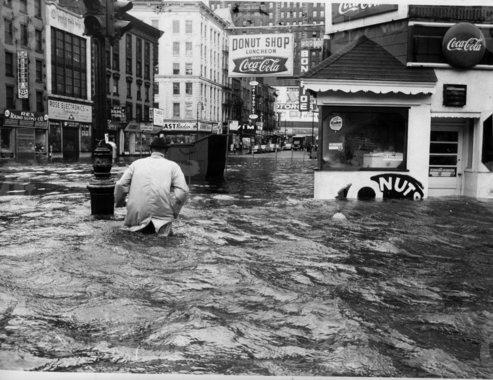
Showing posts with label climate. Show all posts

Tuesday, November 6, 2012

RSS AMSU: 2012 seems to be 11th warmest on record

For almost 15 years, the climate alarmist bigots have been dreaming about another warm year that would dethrone 1998 as the warmest year on the satellite temperature record. It's totally clear by now that year 2012 won't become this divine signal of their holy global warming they have been desperately waiting and praying for. In fact, after the first 10 months, it doesn't seem to make it into the top ten.


The UAH AMSU satellite temperature product recently experienced some problems and had to upgrade to a new version. In this ranking texts, I usually refer to RSS AMSU which seems to be an advantage now.

The ranking of the years 1998-2011 according to RSS AMSU is:

{1998, 0.54871},
{2010, 0.47591},
{2005, 0.330003},
{2003, 0.32197},
{2002, 0.314142},
{2007, 0.258975},
{2001, 0.247164},
{2006, 0.229666},
{2009, 0.225882},
{2004, 0.202923},
{1995, 0.158027},
{2011, 0.147427},
{1999, 0.102792},
{1997, 0.102523},
{1987, 0.0982575},
{2000, 0.0915137},
{1991, 0.081},
{1990, 0.0751534},
{1988, 0.0669781},
{1983, 0.066137},
{2008, 0.0502459},
{1996, 0.0463962},
{1994, 0.0285479},
{1981, 0.0207808},
{1980, 0.0146995},
{1979, –0.0941425},
{1993, –0.117159},
{1989, –0.119378},
{1986, –0.138775},
{1982, –0.1734},
{1992, –0.179363},
{1984, –0.223995},
{1985, –0.260586}.

Sorry for the ludicrous excess precision; I didn't want to spend the time to round the numbers. The average temperature anomaly during the first 10 months of 2012 was +0.2018 °C. If this remained the score for the whole year, 2012 would be the 11th warmest year of the RSS AMSU record.

It's very likely that the November+December 2012 average anomaly will deviate from +0.2018 °C by less than 0.2 °C and because these two months have a 5 times smaller impact than the previous 10 months, I expect the anomaly to change by less than 0.04 °C from the current 0.2018 °C. It seems "very likely" to me.

So 2012 is "very unlikely" to drop to the rank 12th or lower. However, if the last two months of the year will be substantially warmer, 2011 can make it up to the 6th or 7th place, not higher.


BSP (CZ): I don't know. Frost destroys the sunshine...

As I mentioned a month ago, the widely expected 2012-2013 El Niño seems to be delayed, to say the least, and the ENSO neutral conditions continue even though in the latest weekly ENSO report, they're very close to the El Niño threshold again. Without a clear El Niño this winter season, it seems very likely to me that even 2013 will refuse to become the warmest year. That would extend the period without a new warmest year to a whopping 15 years.

Thursday, November 1, 2012

Edward Teller's great H-day: 60 years ago

Ivy Mike released 188 times more energy than Hurricane Sandy
Update: All claims below based on the Sandy energy numbers are wrong and reflecting a temporary credulity and stupidity of mine. See comments for some discussion

Hungarian-Jewish-American physicist Edward Teller had a great day exactly 60 years ago, on November 1st, 1952. For some years, he's been working on an idea originally due to the great physics guru Enrico Fermi (most likely, and one invented in Summer 1942) which totally fascinated him: a bomb getting its energy from thermonuclear fusion.

While fission only releases about \(0.001E=0.001mc^2\) from some mass, fusion is able to get to \(0.01E=0.01mc^2\), one percent of the total latent energy, and it may employ as omnipresent "fuels" as hydrogen.


See the explosion here – the blast (the "Mike shot") takes place at 4:39 – or here at 1:40. There's also a one-hour 1952 program where the explosion occurs at 40:47. Is it just me who feels that the 1950s Americans sound more British? ;-)

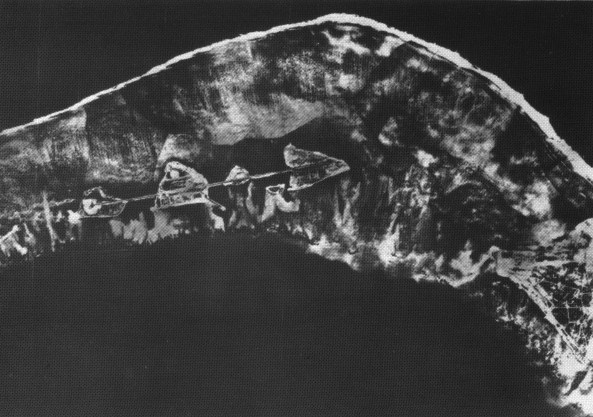
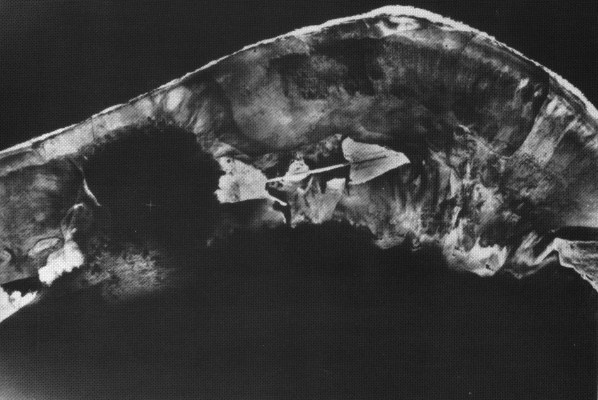
Ivy Mike, the pioneering device based on the Teller-Ulam design, was finally ready for detonation on the Enewetak Atoll (atoll = coral island encircling a lagoon) in the Pacific Ocean: Google Maps, crater (yes, the Elugelab [codenamed Flora] island in the the atoll [not the whole atoll whose radius is 15 km!] ceased to exist and was filled with water; before, after, source).

This device was one of the main reasons we have had peace for many and many decades; Edward Teller should have clearly gotten the Peace Nobel Prize that was jokingly given to the "European Union". How strong was the explosion? And how did the device work?


At the center of the device, there was a cylindrical rod of plutonium, the "sparkplug", that had the task to ignite the fusion reaction. It was surrounded by a natural five-ton uranium "tamper". The external side of the tamper was made of a mixture of lead and polyethylene and these sheets were sending X-rays from the primary to the secondary. The X-rays acted by their huge pressure and temperature.

All the lead, plutonium, and uranium stuff was there just to help the primary actor that was being tested – the cryogenic (=impractical for mobile bombs) liquid deuterium fuel at the very center (plus some tritium) – to get a bit excited and warmed up.

The whole active object, also named "sausage", was encapsulated in 25-30 centimeter thick steel. This whole toy was 54 tons heavy, 619 cm tall, and 203 cm in diameter. With other external components, Ivy Mike weighed over 80 tons (again, that's why it was impractical for mobile weapons). When it exploded, it produced 10-12 megatons of TNT but 77% came from the fission of the uranium "temper" (about 450 kg out of 4.5 tons of the uranium was "burned" releasing the equivalent of almost 8 megatons of TNT) but the remaining 23% may be attributed to fusion. The fireball was 5 km wide and the mushroom went to 17 km altitude in 90 seconds and 30 km in 150 seconds.

Note that 10 megatons of TNT is about 41.84 petajoules i.e. \(41.84\times 10^{15}\,{\rm J}\). Via \(E=mc^2\), that's equivalent to the complete destruction of 0.47 kilograms of matter. Take one-quarter of it (for fusion) and multiply it by 100 to see that about a kilogram of hydrogen was turned mostly into helium or new tritium (and other things).


Via Nuclear Secrecy.COM.

Alexander Ač told us about the energy stored in the otherwise mediocre Hurricane Sandy. His source states that Sandy "contained" – whatever it exactly meant – 0.222 petajoules of energy. It's only larger than the analogous numbers for other, stronger storms because Sandy's figure includes the wind energy from a larger area. If you know how to divide numbers, you can easily calculate that Ivy Mike released the same energy as 188 times the Hurricane Sandy. And it was pretty much produced by one right-wing physicist. That's a simple quantitative explanation why you shouldn't expect right-wing physicists to be overly impressed by the energy of the Hurricane Sandy. ;-)

But if the worshipers of the greenhouse effect and its hypothetical but indefensible effects on the weather events feel humiliated, and they surely should because they are, let me calm them down just a little bit. The research project initiated in 1951 that led to Ivy Mike had a nice name: the Greenhouse. :-D

(Yes, I needed Ivy Mike whose energy was equivalent to 750 Hiroshimas. Hiroshima wasn't enough to beat Sandy; it released about 1/4 of Sandy's energy. On the other hand, NYC rats are stronger than Sandy.)

The crater created by the blast was 3 km wide and 60 meters deep. 80 million tons of rocks were vaporized. The blast didn't proceed as expected – it was two times better i.e. stronger. One pilot who was supposed to pick some air samples died when he ran out of fuel. All elements including Einsteinium and Fermium were produced. A 50-kilometer vicinity of the atoll was substantially radioactively contaminated. You don't want to play with similar toys in the New York City; Sandy is just fine.

Harry Truman who politically supervised the research wasn't the only one. At that time, the Soviets were already working on something similar although their research was arguably not quite independent. Sakharov's Third Idea – the Slavic term for the Teller-Ulam design – got tested in 1955, three years after Ivy Mike (6 times lower yield than Ivy Mike). But already in 1953, one year after Ivy Mike, the USSR tested Joe 4 (0.4 megatons of TNT, 25 times smaller than Ivy Mike) based on a different "Sloika" philosophy. The strongest (thermonuclear or otherwise) man-made explosion ever (so far?) was the Tsar Bomba in 1961. At 57 megatons of TNT, it was 5 times stronger than Ivy Mike and 1,000 times stronger than Hurricane Sandy. Take it, Yankees and weather alarmists. ;-)

Hat tip: Technet.iDNES.cz


P.S.: Just a comment on the energy vs world energy consumption. The Ivy Mike blast may look very large and you could think that it would be great to use it as a generator of energy. But I mentioned that the blast released \(4\times 10^{16}\) joules of energy. It's a lot but the world's annual energy consumption is around \(4\times 10^{20}\) joules so you would have to tame 10,000 Ivy-Mike-like blasts a year to replace the existing sources of energy! But you could imagine it's doable. Forget about peaceful thermonuclear power plants and use a blast to raise a lot of matter to some altitude, or heat it, or something like that. 30 such Ivy Mike blasts a day may produce the electricity for the whole mankind. ;-)

Wednesday, October 31, 2012

Was Sandy systemically caused by CO2?

Anthony Watts wrote down a nice table describing which folks believe or at least pretend to believe that CO2 "caused" Hurricane Sandy and which people don't. If I simplify it a little bit, activists, liars, and crackpots such as Al Gore support the link while scientists don't. I am kind of pleased to see that for the first time, most of the media seem to agree that the people promoting the hurricane-CO2 link are hacks.

I was intrigued by a member of the former group, hardcore leftist activist Mr George Lakoff, who wrote the following text for the Huffington Post:
Global Warming Systemically Caused Hurricane Sandy
He introduces a new problematic term: "systemic causation". He believes that fossil fuels "systemically caused" Hurricane Sandy (and other weather events we don't like). The description makes it look like the construct "A systemically caused B" means "A increased the odds of B" – note that my alternative wording is equally long, much more accurate, and not requiring any new contrived phrases.

Except that Mr Lakoff believes that AIDS is only "systemically caused", not "directly caused", by the HIV virus. That's pretty interesting. Either he is an HIV denier or his definition of "systemic causation" is internally inconsistent. But let's ask two questions: Was Sandy "systemically caused" by CO2 emissions? And forgetting about the answer and focusing on genuine "systemic causes" of bad events in general, is it legitimate for the society to outlaw them?

My answer to both questions is No, although the latter question deserves a subtler discussion.


Unless you believe in astrology and similar things, you will surely agree that it's not in the power of CO2 or any other indirect hypothetical causes to adjust some "highly internal" and "seemingly random" characteristics of tropical storms such as the population of the city that the storms target. ;-)

So the fact that Sandy managed to flood some tunnels in the New York subway system, among dozens of related achievements, is pretty clearly a coincidence that can't be explained by any well-defined long-term "cause", not even a "systemic cause". Most hurricanes avoid New York, some hurricanes get there, and only the proportion may be measured or theoretically calculated. In other words, when we talk about unknown future hurricanes, we may only predict their ability to target New York or other great cities probabilistically. And we may only estimate the probability that the most important hurricane of 2013 will make landing at most 4 days before the Halloween.

(The same comment, "only probabilistic predictions are possible", obviously applies to earthquakes in Italy, too.)

Needless to say, exactly the same words apply to Katrina and New Orleans in 2005. Katrina was a big story – much bigger than Sandy (surely by the number of casualties) – because it hit a large and relatively vulnerable city of New Orleans. Sandy was a relatively big story because it affected the "greatest city in the world" although not as much as Katrina did harm New Orleans. Let's agree that the targeting is a matter of chance.

But if you subtract all the "special characteristics" of Sandy that are related to its random path, there is almost nothing left. In fact, by the Accumulated Cyclone Energy (ACE), Sandy isn't even the largest storm of the 2012 Atlantic hurricane season. It's not even the second one. It's not even the third one: Sandy is just the fourth largest Atlantic tropical storm of 2012. That shouldn't be shocking because it has made it to the Category 2 and only marginally and for a short time.

One may look for various detailed properties of Sandy – its trajectory, its area, its pre-Halloween timing, and so on. But I think it's clear that trying to attribute some "message" (I would say "divine message") to any of these detailed properties is a sign of medieval superstitions. People who try to interpret these properties as divine signals may use a quasi-scientific vocabulary but the vocabulary isn't the essence. The essence is the logic behind their thoughts and beliefs and it is equally unscientific as any other generic medieval superstitions.

The fact that Sandy went to New Jersey is a coincidence – one that could be predicted a few days in advance but one that has no implications for any knowledge or mechanisms that are relevant outside the end of October 2012. The fact that Sandy hit before the Halloween or before the U.S. presidential election is another coincidence. It's totally scientifically implausible to assign "causes" or "systemic causes" to such microscopic accidental characteristics of a tropical storm. Such links are equivalent to astrology and other superstitions. There isn't any conceivable natural mechanism that could impose such causal links – and there's even no conceivable mechanism or explanation that could significantly increase the chance that a hurricane is more Sandy-like if the CO2 concentration is higher. I am convinced that everyone who has been given basic scientific education – or who has a basic scientific intuition even in the absence of any formal education – must know that.

So we are back to the usual questions whether the carbon dioxide in the atmosphere may be increasing or decreasing the number or hurricanes or their average or maximum intensity. I think that the data speak a clear language: no such dependence, whether positive or negative, may be extracted from the data that seem to be fully explainable by "noise", essentially "white noise". In the future, the datasets will become more extensive and perhaps more accurate and people may see a signal we don't see today. That's why it makes sense to ask whether we may predict what they will see. I think (based on arguments I have been repeatedly explained by Richard Lindzen in particular) that if they will ever see such an impact, it should be a negative impact – fewer hurricanes or weaker hurricanes. It's because storminess and other activity is driven by temperature (and other) gradients and in a hypothetical warmer world, the equator-pole temperature difference should be smaller because the poles should warm up faster. The gradients should decrease and because the gradients power the cyclone activity (and other things, including temperature variations in general), the cyclone activity should go down.

That's my prediction but I don't know how strong the effect is. It's probably very weak and it may remain invisible for centuries and perhaps forever because "global warming caused by CO2" will most likely never have an observable effect that would go beyond a modest shift of the global mean temperature.

Even when you look at the 2012 Atlantic hurricane season which became another heavily overhyped one, you will see that the Accumulated Cyclone Energy is just 121 so far, just marginally higher than the historical average around 105. The ACEs for individual seasons are never constant. They belong to some statistical distribution. It's inevitable that sometimes, the ACE ends up being above the average, sometimes (in many years after 2005), it ends up being below the average. There's nothing shocking about either outcome: it's a law of physics that such things are not constant although left-wing, egalitarian activists often have a problem with this totally basic concept underlying all of science.

Standing doctrine vs systemic causes

Despite all the hype, there's no evidence that something is changing about the statistical distributions that encode the number, strength, and geographical location of tropical storms and there's surely no evidence that this unobserved change of the distributions has some particular reasons such as a changing CO2 concentration. We've spent way too much time with this stuff. If someone isn't able to see that my conclusion is the only one that is empirically defensible, he or she probably suffers from some hopeless mania of superstitions and it's probably impossible to rationally talk to such a person.

But I want to continue with my second topic, namely the right of "systemic causes" to lead to bans. Are bans justified by "systemic causes" i.e. causes that only affect undesirable effects probabilistically desirable and compatible with some legal principles of civilized countries based on the rule of law? I would say that the answer is mostly No and if it's Yes, it shouldn't be "complete bans" and the legislation behind some "incentives" shouldn't be dogmatic but it should be based on a careful cost-and-benefit analysis.

What do I mean?

In 2006, I informed about a Massachusetts vs EPA lawsuit that ultimately ended by the unbelievable verdict that CO2 was a pollutant that EPA has the duty to regulate. So far, thank God, this pernicious verdict hasn't been fully exploited but it's a time bomb that may still explode sometime in the future.

In 2006, I discussed an important legal technicality, the standing doctrine:
It says that the plaintiff in front of the federal courts must show that her injury is "concrete and particularized" as well as "actual or imminent". The founding fathers wrote these wise sentences exactly in order to make things like suppression of the freedom of speech or suppression of life and the work of companies with the help of hypothetical accusations impossible.
Using Mr Lakoff's new terms, a person who thinks he has been affected by a "systemic cause" has no standing in the federal courts! Indeed, it's very important that only "direct causes" may be used as arguments against a "culprit". Mr Lakoff's suggestion that we should suddenly start to fight against "systemic causes", i.e. against all kinds of acts and events that have been hypothesized to increase the chance of some undesirable "systemic consequences", is therefore extremely dangerous for the life in the U.S. and elsewhere. Such a program would have a huge potential to restrict the very basic freedoms of the citizens and corporations – well, indeed, this may be the very goal of Mr Lakoff and his comrades.

Our laws are actually already full of various regulations that are meant to suppress "systemic causes", i.e. processes that may increase the chances of undesired consequences. The laws protecting people against passive smoking may be picked as an example.

Science hasn't resolved the question whether passive smoking increases the odds of various bad diseases. There are many theoretical reasons to think that the answer should be Yes. There are also some "maverick" reasons that the influence could actually be going in the opposite direction – explanations emulating the proverb "whatever doesn't kill you makes you stronger" (those things are believed by some in the case of weak radioactivity in particular). I personally think that the former – passive smoking is somewhat unhealthy – is more likely to be true.

However, this uncertainty is often presented using big words and the possible consequences are often presented as far-reaching ones. But this is a complete distortion of what the scientific research has already found out. We don't have reliable data showing that second-hand smoking increases the probability e.g. of lung cancer; and we don't have reliable data showing that second-hand smoking decreases the probability of e.g. lung cancer.

But we actually do have lots of evidence to say that if any of these two influences exists, it's very small! This conclusion of many studies that asked this very question is often being obscured, overlooked, and censored. But it's damn real. If \(p_\text{no smoke}\) is the probability to "catch" lung cancer if you are exposed to no cigarette smoke at all, the probability for second-hand smokers is related to it by something like\[

p_\text{second-hand smokers} = (1.1\pm 0.2) p_\text{no smoke}.

\] This is a number comparable to the results of various surveys. It's not the number from any particular survey but this result is as compatible with them as any single survey from the list of actual surveys and I think it's good to offer you my own number so that you won't overestimate the importance of any particular paper in literature. There is some error margin and the results are compatible with the hypothesis that there's no influence. And they are compatible with the hypothesis that the second-hand smoke slightly increases the risk or slightly decreases the risk (for the latter, the compatibility may be worse).

But the experiments are not compatible with the hypothesis that passive smokers have a doubled risk (or, on the contrary, halved risk) of lung cancer, for example!

That's an important point that will lead you, if you're rational, to realize that the change of lung cancer risks isn't a rational reason to avoid second-hand smoke! There may be other reasons but this simply ain't one of them because if the influence exists, it is weaker than the "noise". Because of genetic and other differences, you may have a 4 times higher risk or 3 times lower risk to develop lung cancer than your friend. You don't really know what the chance is but whether you change the risk by 10% isn't a real issue and if you're unpleasant to your environment because of this small correction to the noise, you may be rightfully viewed as an intolerant jerk. This may increase the chances that someone will kill you so you may be actually shortening your life by being nasty to smokers around you.

But such "systemic causes" that increase the chances of something bad do exist. I could surely find better examples than the second-hand smoke. The society wants to thrive "statistically" so it may invent various policies that "encourage" the systemic causes of good things and "discourage" systemic causes of bad things. But it's important that such legislation shouldn't be dogmatic, black-and-white, and mindless.

Various processes we have may have "good systemic consequences" (good events whose probability is increased by the cause) as well as "bad systemic consequences" (the bad events whose chance is increased by the cause). Both of them must be taken into account. I think that if the "good systemic consequences" prevail – e.g. if we measure them in dollars – it's utterly irrational and counterproductive to legally discourage such "systemic causes".

Needless to say, even if Sandy were fully caused by CO2 emissions in 2012 – in reality, not even 1% of it is "caused" by any carbon dioxide, whether one emitted in 2012 or any other previous year – it would still fail to imply that it's irrational to regulate CO2 using this Sandy justification. The damages caused by Sandy are of order $20 billion. Imagine that this happens every year. However, the damages caused by a full ban (or near-complete ban) on CO2 would be several trillion dollars a year just for the U.S. So even if you believed the totally indefensible hypothesis that "CO2 is the systemic cause behind most Sandy-like hurricanes", it would still be indefensible to introduce laws that (almost) outlaw the carbon dioxide. The actual cost-and-benefits analysis implies that the ban would be at least 3 orders of magnitude more costly than the "damages" it tries to mitigate.

In some cases, we may find out that it's plausible that some acts contribute as "systemic causes" to some undesired consequences. In those cases, it could make sense to create laws that would force the "perpetrators" of the acts identified as "systemic causes" to pay for a corresponding fraction of the damages of the consequences that were "partly or statistically" caused by the acts.

Let me give you an example. Imagine that there's some breakthrough or change and evidence accumulates that 10% of hurricanes like Sandy are caused by the CO2 emissions. If this were true – and I don't believe that the current science suggests anything of the sort but just imagine that it will do so in the future – then it would make sense to introduce legislation that would force the CO2 emitters to pay 10% of the damages caused by future hurricanes similar to Sandy. (Without a new law, prosecution must remain impossible. A judge simply can't prosecute someone for some previously unencountered "systemic causes" because the "guilt" can't be reliably demonstrated so any "guilty" verdict would conflict with the presumption of innocence!)

For "another Sandy" whose damages are $20 billion or so, the "club of all the world's CO2 emitters" would be ordered to pay $2 billion to the fund for the victims of "another Sandy". It would save some money to the insurers and others.

You surely see where I am going. My point is that even if science accumulated evidence that CO2 helps to strengthen similar hurricanes or increase their number, the extra fees that the CO2 emitters after a similar hurricane would have to pay would be totally negligible and they wouldn't change anything whatsoever about their business. Every year, the world's CO2 emitters would pay some extra $2 billion for an Atlantic hurricane, perhaps another billion for another weather event that would be partly blamed on them, and so on. So they could share a $5 billion fine a year.

That's totally negligible because they – and we – collectively waste hundreds of billions of dollars a year by carbon markets and similar policies to regulate the CO2 emissions.

Even if you decided that the largest hurricanes we experience are partially – significantly – "systemically caused" by CO2, the damages would still be vastly smaller than the costs of the war on CO2. The insane people who defend the policies regulating CO2 need much more than an indefensible attribution of weather events to the gas we call life: they need to invent tons of events and devastation that doesn't exist at all. They need a full, unrestricted demagogy. They are living outside the reality and their survival depends on their complete separation from the reality and from the truth.

It's very important to keep all those events and hypothetical causal relationships in the context and to assign them numbers. Even if human lives are at stake, you must talk about numbers. You either count the human lives separately or identify a human life with XY million dollars, whatever the right number is, but it's totally critical to do so and to preserve a rational thinking at every step. The failure to do so opens the door to the demagogy by unhinged medieval superstitious assholes such as the scum that wants to fight against the carbon dioxide. And once these jerks see the open door, they won't hesitate to scream that an influence that is actually very insignificant, cheap, and de facto negligible (for the mankind and for the CO2 emitters) is practically infinite and Universe-threatening and enough for them to demand everything, ban anything they want, and become de facto dictators of the society.

We mustn't allow anything of the sort. We must preserve the rational and quantitative reasoning. If we manage to do so, we will inevitably protect our legal systems and habits from counterproductive policies such as the carbon regulation – and from many other bad rules that refer to "externalities" and similar things that are actually negligible if looked at properly.

And that's the memo.
Monday, October 29, 2012

Is Hurricane Sandy unprecedented?

East Coast people's reports about their observations and courage are more than welcome

Update ex post facto: Sandy deserves the label "non-event" even more so than Irene did

The media are full of panic and strong words inspired by Hurricane Sandy, the "Frankenstorm" as some writers nicknamed it. Of course, this moniker – perhaps originally meant to indicate the Halloween time – is popular especially among those crackpots who want to argue that the storm is "man-made". Others are more modest and use the terms "mammoth, monster, superstorm" for Sandy.


A region of the New Jersey and Delaware coast is predicted to be "more like than not" to experience hurricane speeds (at least once, the 1-minute average speed must be above 74 mph). Also, see a photo gallery (27 pics) and the live broadcast from Weather Channel.

Events are being cancelled, institutions and major parts of the public transportation systems are being closed, and hundreds of thousands of people are being evacuated because of the late Category 1 hurricane that should land somewhere in New Jersey sometime on Monday evening, Eastern Daylight Saving Time, i.e. Tuesday morning European time. You may observe the predicted speed and status of the storm at the NOAA website.

I understand the sentiments behind the caution. On the other hand, I understand the skeptics much better. Many people clearly remember an isomorphic hysteria before the landing of Hurricane Irene in August 2011 which turned out to be a non-event. I remember a hurricane sometime around 2005 which was announced to land in New England – but the outcome could have been summarized by the sentence "It is raining in Boston".
Webcam: Try the rainy before-the-storm business-as-usual at The Times Square, other NYC places (sorry, the website may be overloaded)
The media are helping to preserve a certain kind of group think, a nearly religious admiration for the hurricane and its overwhelming power. I surely have the feeling that those people who refuse to evacuate their homes are considered heretics. They are not allowed to coherently describe their position in the media. But they have a rather good basis for their position, too.


Is this hurricane unprecedented? Well, it's a hurricane that comes late in the season so it may bring snow, too. (Some sources talk about an unprecedented interplay between a hurricane and some Arctic air, and so on, but they haven't really done research whether this interplay is unprecedented, either.) Also, it will manage to land in New Jersey which is pretty far from the equator and the most typical places where hurricanes land if they land at all. Also, this hurricane is targeting New Jersey, nearby places, and perhaps New York. The City is even more inhabited than New Orleans and the proper targeting is what matters for the relevance of a hurricane, indeed.

However, none of these features is really unprecedented.


Sorry, this was the Twitter #Sandy real-time timeline brought to you by TRF. I hope that we haven't lost you.

Even when you restrict your attention to hurricanes affecting New Jersey, you may find many stories in the book linked at the top or in this summary. The web page offers you 21 hurricanes between 1821 and 2011 that affected New Jersey. Irene 2011 was a hurricane that landed in New Jersey – still, most people already forgot whether it was lethal or not – but it wasn't the first hurricane with this "citizenship". On September 16th, 1903, a borderline hurricane landed near Atlantic City. Its main effect could be summarized as four inches of rainfall. Some significant hurricanes affected New Jersey in 1821, 1878, 1889, the history is quite nontrivial.

And I have focused on proud New Jersey hurricanes. If we looked elsewhere, we could enumerate tons of other hurricanes, such as the 1960 Hurricane Donna that has improved Manhattan in this way:


What about late-season hurricanes in New Jersey? Sandy must be the first one, right? Well, Hurricane Hazel landed on October 15th, 1954. And you may find much later ones. On December 2nd and 3rd, 1925, a hurricane brought 70 mph winds to Atlantic City. So calling Sandy "unprecedented" means to be ignorant about the history, sometimes very recent history. There's nothing unprecedented about hurricanes landing in New Jersey, not even about the subset that lands in October.

The journalists like to hype things because it brings them profit. Every time the end of the world arrives on the following morning, lots of newspapers are sold. But maybe they also partly want to "help the nation" and by making the stories more dramatic, they make the people more disciplined. I have some understanding for all these things. But I would be much happier to see something different as well – journalists as impartial messengers who actually describe what is happening, how people respond, and what their reasons are. A large fraction of the citizens are skeptical about the "catastrophic predictions" and many of them have decided not to evacuate their homes for reasons that are often rather sound. It would be nice if the journalists sometimes behaved as journalists in a free society – which means journalists who report and allow the readers and viewers to decide – and they were not trying to pretend that all these people are uneducated hacks and criminals and that the journalists' main holy duty is to strengthen the influence of the "authorities".

A hurricane lands somewhere in the U.S. almost every year and while it's good when the public cooperates with its representatives, it's simply unreasonable to consider all such situations "exceptional states of war" equivalent to "martial law" because we would be living under such "martial law" most of our lives (hurricanes are not the only reasons that may spark such "exceptional" measures).

I am not claiming that Sandy must turn out to be another non-event; I don't really know. The wind are strong enough so that you don't want to walk in the middle of your town. But it's rather plausible that it will be another non-event and it's wrong for the society to pretend it is not plausible, not even if this game is supposed to help a "good cause".

Sunday, October 28, 2012

Doha, Qatar will host a climate conference

What a paradox!

Qatar is a peninsula located on the opposite side of the Pilsner Gulf than Iran. Its economy is the wealthiest one not only in the Islamic world – even in comparison with Kuwait and UAE – but it's almost certainly richer than the economy of your country. The GDP per capita exceeds $100,000; no kidding. Not bad for a nation (2 million people) whose average IQ is 78. Sometimes if your ancestors are dumb enough to choose a desert as their home, you may benefit out of the stupidity because even a desert may harbor amazing wealth.


The conference center above in the capital, Doha, will host the 18th session of the Conference of Parties of the UNFCCC, the loons who want to regulate carbon dioxide. That's what I call an irony. ;-) The meeting will start in one month, on November 26th, and will continue through December 7th.


You must have seen some of the unbelievable projects showing the incredible wealth of Qatar. I will return to them momentarily. Where does the wealth come from? Well, yes: it's mostly about oil. Petroleum represents over 60% of the GDP, 70% of the government revenue, and 85% of export earnings. And make no doubts about it: even the remaining part of the GDP is inflated because the products and services are sold to people who are rich because of the oil (see costs of living in Doha: 1 Qatari Riyal is $0.27) so the export fraction 85% is surely a more faithful representation of the relative importance of the petroleum.

Now, this nation hosts a conference of nutcases who want to regulate if not ban fossil fuels. Do you really believe that the folks in Qatar want to do something like that and send their economy towards another Islamic role model such as Bangladesh whose average IQ is actually higher, 82, but due to the absence of petroleum, its GDP per capita is 60 times lower than the Qatari one? Do you think it's fair that Poland whose GDP per capita is 6 times lower is being harassed because of every new coal power plant while the people who annually export oil for more money than the whole Pole's annual income are treated as generous hosts who are surely helping Pachauri et al. to fight against the evil fossil fuels, aren't they?

Maybe the Qatari folks – who have the highest per-capita CO2 production in the world – will get an exception for their good services to UNFCCC, just like Al Gore and lots of other privileged assholes who don't walk the walk.

It's just totally crazy. All the participants of the climate conference must know that it is just a preposterous theater, a sequence of crazy excuses for an exotic trip, an attempt to create policies that are so incredibly unjust and irrational that they simply can't be adopted by almost any nation. Everyone must know that the true believers who will go to Doha are much more irritated by climate skeptics who are trashing their pathological climatic religion than by those who are producing and selling megatons of fossil fuels.

Now, let me return to their not quite cheap projects.


This is Syd Mead's plan to rebuild Doha. Personal jets flying around skyscrapers resembling huge wine glasses, or whatever it is. It may look like a picture from science-fiction novels except that many very similar projects are becoming a reality on a daily basis. For example, Pearl-Qatar is a multi-billion artificial island with skyscraper homes. See Google Maps to verify it is real.


Check also the "sustainable" Amphibious floating island. They probably also have some rotating skyscrapers even though the picture below may be from Dubai (in United Arab Emirates).


Sure, all these people will be thrilled by the ideas to ban fossil fuel. Also, they like means of transportations that don't depend on fossil fuels, for example bicycles. So Doha built a 35-kilometer-long network of cycling paths:


This is a paradise of energy-efficient transportation. Well, wait a minute. This cycling path is actually fully air-conditioned by mist. Imagine that while the EU or EPA bureaucrats are terrorizing you for turning on an incandescent light bulb, the biker on the picture enjoys the ride through 35 kilometers (yes, longer than the LHC) of a thick, not isolated tunnel that is cooled down from 115 Fahrenheit degrees i.e. 46 Celsius degrees (in the summer, average high is 41 °C i.e. 106 °F) to pleasant temperatures. Relatively to an incandescent light bulb, you surely don't need much energy for such a megafridge of pleasure that was built inside a desert, do you? ;-)


Well, a desert, sorry, I didn't want to insult you. For over $5 million, one hectare of the desert is going to pretend it is green. In the Czech Republic, you may buy one hectare of a forest for $2,500-$20,000, about three orders of magnitude cheaper than in Doha.


There are of course some projects related to the production of gas and other fossil fuels, for example the modest construction above. Also, Qatar will host the 2022 World Cup so it will build about a dozen of stadiums similar to the picture below – click at it for more (most of them are powered by solar panels):


Or compare this railway station with the railway station in your town or city:


Or check some of the hotels in Qatar.

I could go on and on and on. A vast majority of all these things has been paid, is being paid, or will be paid from oil revenue. But the climate warriors are going to transform Qatar to a global symbol of the fight against fossil fuels next month, anyway. The number of psychiatrists in the world is clearly insufficient to deal with this overload of cases. ;-)

Wednesday, October 24, 2012

PBS Frontline: Climate of Doubt

PBS, a major U.S. Public TV station, has aired this 54-minute documentary, The Climate of Doubt:


See also additional PBS material on the program.

The program – starting with some video sequences from the latest Heartland Climate Skeptics Conference in Chicago – was largely criticized by Joe Bast of Heartland, Tom Harris of Canada, and some pre-program comments were mentioned by Chris Horner and The Heartland Institute. Gavin Schmidt posted the video on Real Climate, mostly to boast that he has appeared for a few seconds, too.

I think that a viewer will have no doubts that the creators of the program are hostile towards the skeptics – due to the constant usage of offensive words such as "contrarians" and due to the hostile faces of the host (especially John Hockenberry), among a few other reasons. On the other hand, I think that this program has done a relatively fair and open job when it comes to the revelation of the information for the viewers, especially the information about the changes of the debate in recent years.


¨

It seems to me that most of the viewers understood that the climate skeptics are damn reasonable, educated, and kind of nice people. There are many of them – the number of "visible" climate skeptics among scientists isn't really lower than the number of "visible" climate alarmists.

While the program tried to claim otherwise, I guess that an intelligent viewer will understand that using a World War II analogy, the climate change controversy is like the war and the alarmists resemble the Axis powers while the skeptics are like the Allied forces. The Axis powers may be more tightly packed, they may demand a stricter discipline from themselves and from everyone else, and they may be spending more time by spreading the idea that their ultimate victory is inevitable. But even from their programs, an intelligent viewer must understand that the Allied forces are at least comparably powerful, they may be right, they seem to offer observations and arguments that are almost certainly right even now, they may already be winning battles, and they may soon celebrate the final victory in the war.

The idea that the Axis powers have some unbreakable superiority is a meme that just the most intellectually limited viewers may be eager to buy – at least I hope so – and I am kind of not afraid of it. I don't think it's too important what the people who can easily be brainwashed by a transparent propaganda think. What matters are the skeptical people who began to be somewhat interested in the issue, who understand other things, and who won't be fooled easily. And I am confident that this PBS program only helped those people to fall in love with the climate skeptics.

But the hostile tone towards climate skepticism notwithstanding, the program acknowledged that the bulk of America went pretty much skeptical in recent years. Surprisingly, it also acknowledged that Al Gore is a divisive asshole who helped the skeptics to strengthen even more. The viewers could hear some short "excerpts" from the skeptics who speak about the actual science – although the scientific "technicality" were not the main focus of the documentary.

At some points, both alarmists and skeptics are saying things. And such segments often reminded me of the first Obama-Romney debate. For example, around 10:30, you may compare John Kerry and Myron Ebell. Kerry is subdued and seems to have developed bad conscience. He seems to admit a sequence of recent defeats and the non-existence of the actual consensus. Ebell speaks confidently, as a person whose words have already been pretty much established.

So I believe that this program, a mixture of an apparently prejudiced tone against the climate skeptics and some facts about the skeptics' victories, their decency, education, arguments, upward trend of their influence, and their rather large number as well as the subtle hints about the alarmists' dishonesty that may be seen in the program, despite the clear attempt to create a pro-alarmist program, will help America to become one additional little bit more skeptical again.

I would grade this program on the recent years in the climate debate: B. The biased language and the narrator's apparent bias penetrating the program is my only complaint.

Czech police uncovers a $20 million carbon credit fraud

A day later, it also foils a $100 million solar fraud

The most straightforward way to learn what's going on with carbon trading in my country is... to read e-mails from a well-informed Malaysian American at Harvard. ;-)


The CZK 1,000 banknote was chosen as the World's Best New Banknote in 2008 by the Association of Currency Affairs.

Willie Soon sent me this URL:
Police suspect two of carbon credit fraud worth CZK 378m (Prague Monitor)

News in Czech
One U.S. dollar is worth 19 Czech crowns (CZK) so the amount these two men earned was nice, $20 million. Some real estate worth half a million dollars was already blocked.

The "trick" wasn't too difficult. They bought and sent some carbon indulgences. Officially, they pretended that both transactions occurred within Czechia. As payers of the 20% or so value-added-tax (VAT), they would buy the carbon permits for an increased price with the VAT tax included, i.e. 120% of the "tax-free price", and they would sell it for a price including VAT, too. They would pay the 20% VAT as the difference between the 20% VAT they received for the sale and the 20% VAT they had to pay during the purchase.

(All the "VAT payers" – usually companies except for tiny ones – get all the VAT they pay back. The only folks who don't get the VAT back and who "really" pay it are the regular consumers etc. who are paradoxically called "VAT non-payers", and that's why the government ultimately gets some money from the VAT game.)

Under normal circumstances, a VAT payer (I had to become a VAT payer as well, due to some small amounts and crazy EU laws) would sell it for the same amount as the price for which he bought it. That would include the tax and our IRS would return nothing if both transactions involved the same amount of money. No profit, no loss. VAT is about the "added value" and nothing is added if you just buy and sell for the same price. However...


However, in reality, they actually bought the carbon credits outside the Czech Republic, in another EU member state. It means that they didn't actually pay any VAT – although they later requested that the Czech IRS de facto "returns them" this tax they haven't paid. They had to "reclassify" the purchase as an internal Czech transaction.

This is probably particularly simple in the case of carbon credits because their actual value (which is a completely artificial construct) is something that no one really understands, especially if you start to move the credits from one country to another. I am pretty confident that our Pilsner IRS officers who sometimes harass ordinary people because of a few crowns wouldn't dare to question similar transactions because it's over their heads. Fortunately, the anti-corruption police in Prague knows better.

The men face up to 10 years in prison. However, due to the messiness and irrationality of this "carbon market", there may exist lots of people with similar nice profits who will never be caught.


A solar fraud for $100 million

You may think that the two men above are just bad apples and exceptions. Well, one day after the information about $20 million carbon fraud above, we were told about another success in the Czech anti-corruption police's campaign against assorted environmental and renewable fraudsters that was celebrated just one day later, namely three hours ago.
Anti-corruption police accused 9 people, foiled a $100 million solar fraud (Czech radio, automatic translation)
Among the 9 accused people, three are pretty interesting because they're employees of the National Energy Market Regulation Office which supervises the photovoltaic industry in my country.

In 2010, the fraudsters managed to get stamps on all the paperwork proving that two solar power plants in Northern Bohemia began operation. The advantage was that this achievement guaranteed subsidies – well, guaranteed much-higher-than-market price for the produced electricity to be purchased by the state – for the next 20 years. The subsidies for power plants started after 2010 have already been substantially lower.

There was only one problem with these two solar power plants in 2010: they didn't exist in the reality yet. You may agree that it's irresistible to acquire all the paperwork that is needed to get insanely high subsidies for nothing. If you could build 100 solar power plants (on the paper or, perhaps in the future when you're rich, in the reality as well) with a guaranteed profit for 20 years, you would want to do it.

The profit of the "group of nine little Czech Al Gores" (stolen subsidies that shouldn't have been paid) was quantified as $100 million (two billion Czech crowns) – comparable to one American Al Gore's net worth. The police has ordered the court to arrest the three bureaucrats. In America, Al Gore remains at large.

Incidentally, the Czech government decided today to significantly shrink the subsidies for the renewable sources once again – which is good. However, the rules of the game are such that the government will indirectly force the consumers to pay these subsidies instead – which is bad. The latter fact will make the electricity 2-4 percent more expensive since 2013. See Electricity price will jump again; due to the premium for green energy (automatic translation).

At the same moment, companies' mandatory fee for renewable energy should jump from CZK 419 to CZK 613 since January 2013. A coalition of Czech industrialists sent a complaint (autom. translation) to the government against the liquidating ransom in which they warned against coming losses, bankruptcies, and tens of thousands of new unemployed people.

Especially the Northeastern region of North Moravia near Ostrava – which is rather poor and has depended on coal and steel to make living for quite some time – has been switched to a revolutionary mood (autom. translation). If you're an advocate of the global warming hysteria, renewable energy, and similar pathological concepts, I recommend you not to travel to Ostrava because your mouth could be reshaped in the way that no one has dared to reshape your mouth yet even though it should have been done for many years.

Tuesday, October 23, 2012

Climate hysteria in presidential debates RIP (1988-2008)

In the hot summer of 1988, James Hansen gave his notorious and by now perfectly discredited testimony in front of the U.S. Congress in which he has predicted approximately 1 °C of warming for the following 25 years. It was an election year in America and the the first one in which the "climate will dangerously change" meme has made it to the presidential debates.


As this video reminds us, the topic was discussed by the candidates in 1988 (especially the VP candidates; thanks, Gene!), 1992, 1996, 2000, 2004, and 2008. Six times. That's it. Thank God. The accumulating years of experience showing that a panic is unjustifiable, the public's growing knowledge of the climate science, the 2009 ClimateGate, and the natural aging process have teamed up to guarantee that the climate panic hasn't been mentioned once in the 2012 presidential debates:
US presidential debates' great unmentionable: climate change (Guardian, Suzanne Goldenberg from the U.S.)
Well, of course, I am talking about the debates between the two candidates who have a material chance to win the presidency in two weeks.

Jill Stein, the Green Party candidate, is still promoting the climate hysteria. She has reclassified Barack Obama as a climate denier – welcome to the club, Barack – which actually means that she has reclassified her own climate alarmist movement as an extremist movement, next to the Nazis and communists, that has nothing to do with mainstream U.S. politics anymore.


I think that the "soft landing" is a natural form of slow death for this opportunistic, frequently mutating disease of the mankind. The candidates don't really know whether it would help them to mention the topic in one way or another so they prefer to keep it safe and say nothing about the topic. In 2016, once this hysteria cools down a little bit more, the candidates may already possess the hindsight that some of us have had for decades – and they will build upon the wiser atmosphere in the society – needed to openly admit that this whole hysteria will have been (and already has been) a completely irrational mass hysteria that the world economy has paid a trillion of dollars for (but it could have been much much worse).

Barack Obama gets something like C– from the climate activists. So you may imagine they are split into various groups that disagree whether or not a candidate with such bad grades deserves to be actively supported against a candidate who may be getting a D from them now – but who has actually gotten an A from Al Gore just 17 months ago, an "achievement" that Obama may have never achieved.

At the same moment when the climate insanity dropped from the top U.S. presidential politics, some journalists and activists claim that a majority of Americans – perhaps up to 70 percent – endorse the talking points defining the global warming doctrine. The only problem with this claim is that the study backing it wasn't prepared by a credible polling agency but rather by the hired guns at Yale's Department for Climate Hysteria and General Environmentalist Propaganda – the "faculty" at that place includes people like porn writer and train dispatcher Rajendra Pachauri and others. So you may be pretty sure that this "study" has nothing to do with the reality and the candidates know it very well.

We're not there yet but once mainstream America becomes really detoxified of this global warming junk, we in Europe and elsewhere will be looking at the other side of the ocean with hopes that our U.S. friends will kindly help us to detoxify our top-tier political systems, too (especially the EU-level layer in our case of the old continent) – in a similar way as they did in 1944-1945 but perhaps with much smaller casualties. ;-)

Via Marc Morano


P.S.: Meanwhile, Czech president and global warming skeptic Klaus is as environmentally friendly – when it comes to walking the walk or, more precisely, biking the bike – as you can get. In China, he appeared on billboards promoting electricity-powered bikes. He didn't get any royalties; in fact, it was a surprise for him he's been used. ;-)